The heat is flowing through a rod of length $50 cm$ and area of cross-section $5c{m^2}$. Its ends are respectively at ${25^o}C$ and ${125^o}C$. The coefficient of thermal conductivity of the material of the rod is $0.092 kcal/m×s×^\circ C$. The temperature gradient in the rod is
Easy
Download our app for free and get started
(a) Temperature gradient $\frac{{d\theta }}{{dx}} = \frac{{{{(125 - 25)}^o}C}}{{50\;cm}} = 2^\circ C/cm$

Download our appand get started for free
Experience the future of education. Simply download our apps or reach out to us for more information. Let's shape the future of learning together!No signup needed.*
Similar Questions
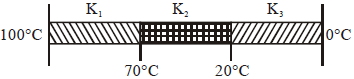
- 1Three rods of identical cross-section and lengths are made of three different materials of thermal conductivity $K _{1}, K _{2},$ and $K _{3}$, respectively. They are joined together at their ends to make a long rod (see figure). One end of the long rod is maintained at $100^{\circ} C$ and the ther at $0^{\circ} C$ (see figure). If the joints of the rod are at $70^{\circ} C$ and $20^{\circ} C$ in steady state and there is no loss of energy from the surface of the rod, the correct relationship between $K _{1}, K _{2}$ and $K _{3}$ isView Solution
- 2View SolutionIn which of the following process, convection does not take place primarily
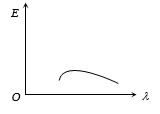
- 3The energy distribution $E$ with the wavelength $(\lambda )$ for the black body radiation at temperature $T\;Kelvin$is shown in the figure. As the temperature is increased the maxima willView Solution
- 4A body takes $5$ minutes to cool from $90^oC$ to $60^oC$. If the temperature of the surroundings is $20^oC$, the time taken by it to cool from $60^oC$ to $30^oC$ will be ...... $\min.$View Solution
- 5A solid cube and a solid sphere of the same material have equal surface area. Both are at the same temperature ${120^o}C$, thenView Solution
- 6View SolutionGravitational force is required for
- 7View SolutionOn increasing the temperature of a substance gradually, which of the following colours will be noticed by you
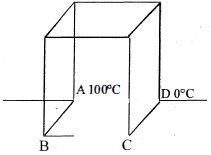
- 8Find Temperature difference between $B$ and $C$ ? (All rods are identical)View Solution
- 9Three rods made of the same material and having same cross-sectional area but different lengths $10\, cm, 20\, cm$ and $30\, cm$ are joined as shown. The temperature of the junction is......... $^oC$View Solution
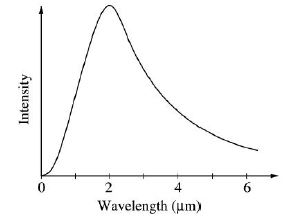
- 10The distribution of relative intensity $I (\lambda)$ of blackbody radiation from a solid object versus the wavelength $\lambda$ is shown in the figure. If the Wien displacement law onstant is $2.9 × 10^{-3}\ mK$, what is the approximate temperature of the object ....... $K$View Solution