MCQ
The height upto which water will rise in a capillary tube will be
  • A
    Maximum when water temperature is $4°C$
  • B
    Maximum when water temperature is $0°C$
  • Minimum when water temperature is $4°C$
  • D
    Same at all temperatures

Answer

Correct option: C.
Minimum when water temperature is $4°C$
c
(c) $h = \frac{{2T\cos \theta }}{{rdg}}$. For water, density is maximum at ${4^o}C$, so the height is minimum at ${4^o}C$.

Need a full question paper?

Generate a complete, print-ready paper with questions like this in minutes — across 16+ boards, with answer keys.
Start Generating Free

Similar questions

When a photon stimulates the emission of another photon, the two photons have:
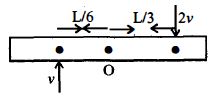
A thin uniform bar of length $L$ and mass $8\,m$ lies on a smooth horizontal table. Two point masses $m$ and $2\,m$ moving in the same horizontal plane from opposite sides of the bar with speeds $2v$ and $v$ respectively. The masses stick to the bar after collision at a distance $\frac{L}{3}$ and $\frac{L}{6}$ respectively from the centre of the bar. If the bar starts rotating about its center of mass as a result of collision, the angular speed of the bar will be
$5\,\,gm.$  of ice at $0\,^oC$  is dropped in a beaker containing $20\,\,gm.$ of water at $40\,^oC.$ The final temperature will be  ........ $^oC$
A particle executes simple harmonic motion according to equation $4 \frac{d^2 x}{d t^2}+320 x=0$. Its time period of oscillation is .........
$Assertion$ : Space rocket are usually launched in the equatorial line from west to east
$Reason$ : The acceleration due to gravity is minimum at the equator.
A monkey of mass $50\,kg$ climbs on a rope which can withstand the tension $(T)$ of $350\,N$. If monkey initially climbs down with an acceleration of $4\,m / s ^{2}$ and then climbs up with an acceleration of $5\,m / s ^{2}$. Choose the correct option $\left( g =10\,m / s ^{2}\right)$
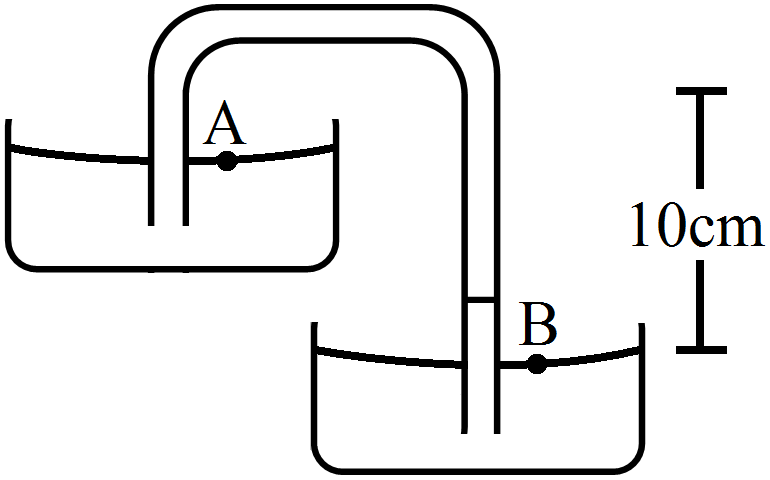
Figure shows a siphon. The liquid shown is water. The pressure difference $P_a P_A$ between the points $A$ and $B$ is the reading will be:
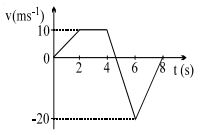
The figure shows a velocity-time graph of a particle moving along a straight line  Identify the region in which the rate of change of velocity $\left| {\frac{{\Delta \vec v}}{{\Delta t}}} \right|$ of the particle is maximum
Which of the following quantities is zero on an average for the molecules of an ideal gas in equilibrium?
A force $\text{F}=-\text{kx}^2(\text{x}\neq0)$ acts on a particle in $X-$direction. Find the work done by the force in displacing the particle from $x = -a$ to $x = 2a.$