Question
✓
Answer
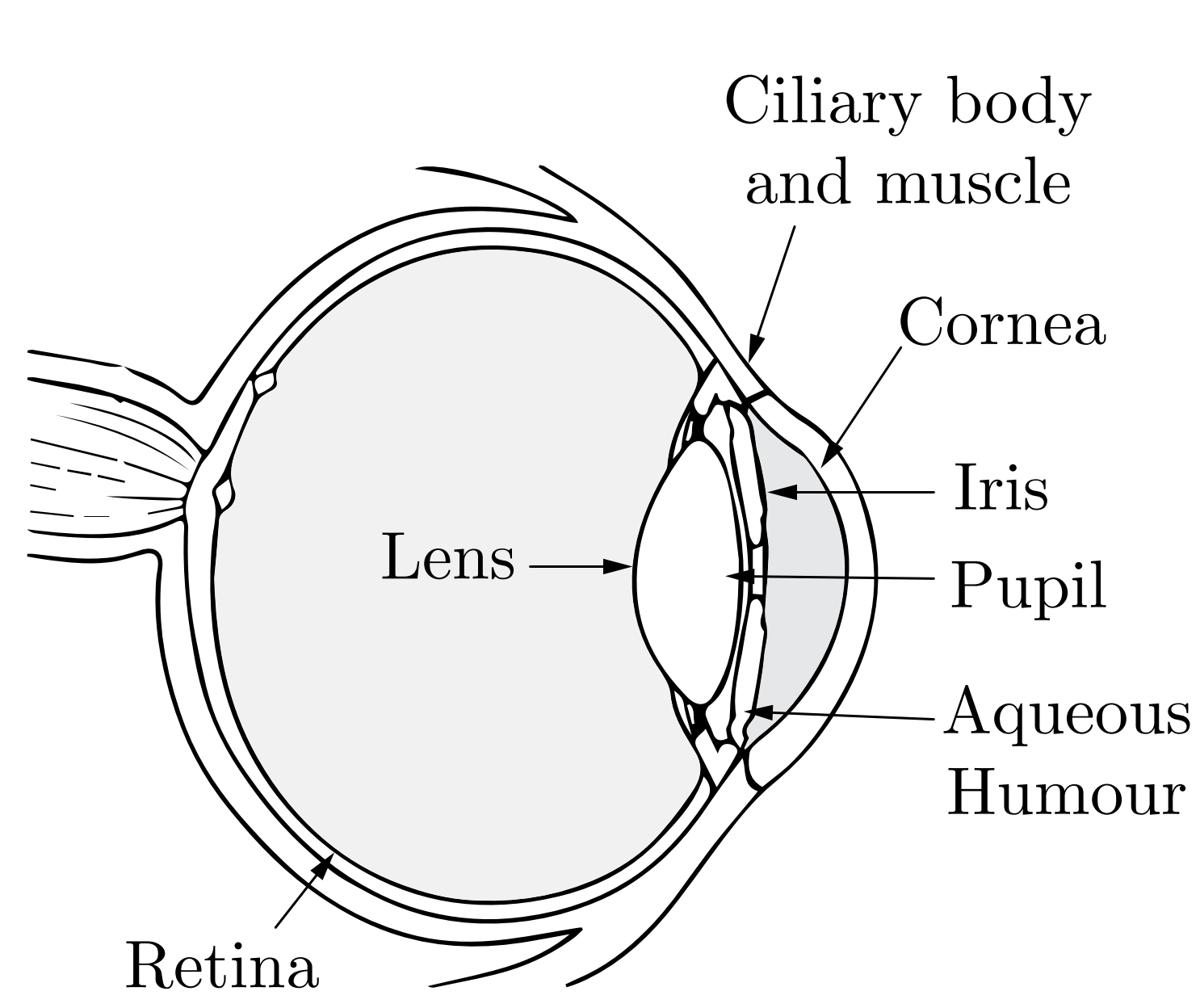
(i) The pupil regulates and controls the amount of light.
(ii) The far point is infinity and near point is about 25 $cm$ of the normal human eye.
(iii) The student is suffering from short-sightedness or myopia.
or
(iv) Iris is a dark muscular diaphragm that controls the size of the pupil.
(ii) The far point is infinity and near point is about 25 $cm$ of the normal human eye.
(iii) The student is suffering from short-sightedness or myopia.
or
(iv) Iris is a dark muscular diaphragm that controls the size of the pupil.
Need a full question paper?
Generate a complete, print-ready paper with questions like this in minutes — across 16+ boards, with answer keys.
Explore more
Similar questions
Leena creates an electric circuit with three resistors R1, R2 and R3.
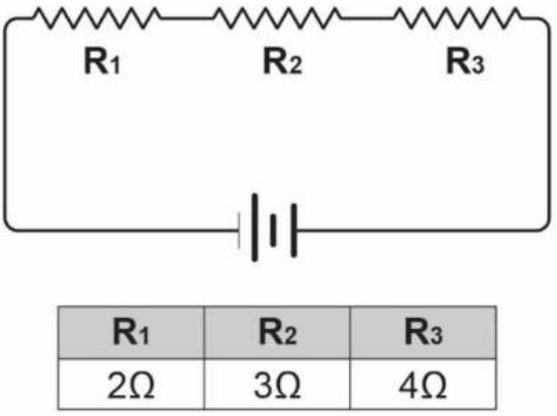
9. What is the equivalent resistance of the circuit?
A. 3 Ω
B. 4 Ω
C. 5 Ω
D. 9 Ω
9. What is the equivalent resistance of the circuit?
A. 3 Ω
B. 4 Ω
C. 5 Ω
D. 9 Ω
A concave mirror forms image of an object thrice in its size on a screen. Magnification of a mirror gives information about the size of the image relative to the object. It is defined as the ratio of size of image to the size of object. It is represented by $m$.
\[
m=\frac{\text { Size of image }}{\text { Size of object }}
\]
Sign of magnification by mirror gives the information about the nature of the image produce by it.
(i) Describe the nature of image formed.
(ii) If the object $x$ distance from the pole of mirror, then find image distance from the pole.
(iii) If the radius of curvature of mirror is $R$, then write the relation between object distance, image distance and focal length of the mirror.
or
(iv) Give one use of concave mirror.
→\[
m=\frac{\text { Size of image }}{\text { Size of object }}
\]
Sign of magnification by mirror gives the information about the nature of the image produce by it.
(i) Describe the nature of image formed.
(ii) If the object $x$ distance from the pole of mirror, then find image distance from the pole.
(iii) If the radius of curvature of mirror is $R$, then write the relation between object distance, image distance and focal length of the mirror.
or
(iv) Give one use of concave mirror.
An insulated copper wire wound on a cylindrical cardboard tube such that its length is greater than its diameter is called a solenoid. When an electric current is passed through the solenoid, it produces a magnetic field around it. The magnetic field produced by a current-carrying solenoid is similar to the magnetic field produced by a bar magnet. The field lines inside the solenoid are in the form of parallel straight lines. The strong magnetic field produced inside a current-carrying solenoid can be used to magnetize a piece of a magnetic material like soft iron when placed inside the solenoid. The strength of the magnetic field produced by a current-carrying solenoid is directly proportional to the number of turns and strength of the current in the solenoid.
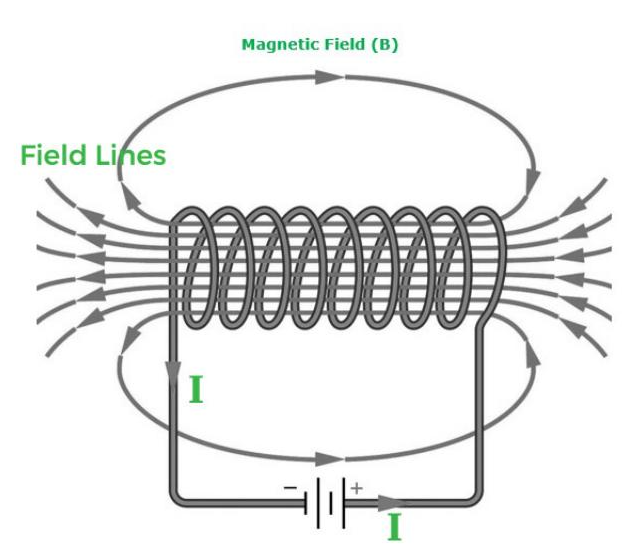
i. What would be the strength of the magnetic field inside a long current-carrying straight solenoid?
ii. Which end is north and which end is south pole when current flows through a solenoid?
iii. A long solenoid carrying a current produces a magnetic field B along its axis. If the current is double and the number of turns per cm is halved, then what will be the new value of the magnetic field?
OR
A soft iron bar is enclosed by a coil of insulated copper wire as shown in the figure. When the plug of the key is closed, then where would the face B of the iron bar be marked?
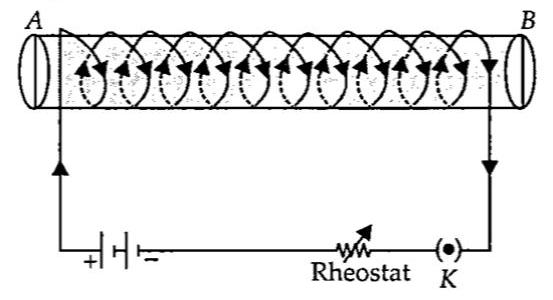
i. What would be the strength of the magnetic field inside a long current-carrying straight solenoid?
ii. Which end is north and which end is south pole when current flows through a solenoid?
iii. A long solenoid carrying a current produces a magnetic field B along its axis. If the current is double and the number of turns per cm is halved, then what will be the new value of the magnetic field?
OR
A soft iron bar is enclosed by a coil of insulated copper wire as shown in the figure. When the plug of the key is closed, then where would the face B of the iron bar be marked?
Leena creates an electric circuit with three resistors R1, R2 and R3.
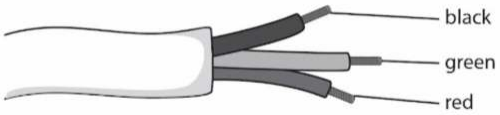
9. Which wire should be connected to the negative terminal of a socket?
9. Which wire should be connected to the negative terminal of a socket?
Lenses are objects made of transparent materials such as glass or clear plastic that has curved surfaces. Diverging lenses are thicker at their edges than at their centres and makes light rays passing through them spread out. Converging lenses are thicker in their middle than at this edges and make light rays passing through them focus at a point. These are used in spectacles to help people with poor vision see better. The converging lenses magnify by bending the rays of light that pass through them to meet at a point called focus. Thicker the converging lens is at its centre, the more its magnifies and closer the focus is to the lens.
(i) Ravi uses two lenses $A$ and $B$ of same size and same material as shown. $P _1$ and $P _2$ are the powers of $A$ and B. An object is kept at the same distance from the lens between $F$ and $2 F$ of each lens on the principal axis in turn. Let $I_1$ and $I_2$ be the image formed by two lenses respectively. What is the relation of image distances of both lens?
(ii) Write down the relation between the power of lens of both lenses ?
(iii) Meenakshi uses above two lenses $A$ and $B$ along with another two lenses $C$ and $D$, as shown :
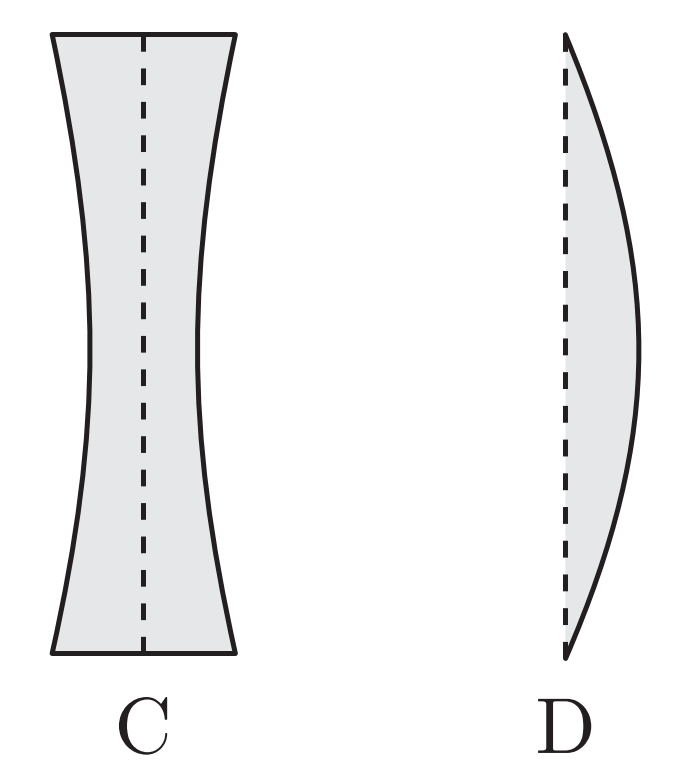
She is able to see the subject matter on the black board while sitting in the front row in the classroom but is unable to see the same matter while sitting in the last row.
Which of the above four lenses will she require to correct the defect in her vision? Why ?
or
(iv) Natasha places an object on the principal axis of above given lens A. One end of this object coincides with the focus $F$ and the other end with $2 F$. What will be the nature of the image formed by the lens on the other side?
→(i) Ravi uses two lenses $A$ and $B$ of same size and same material as shown. $P _1$ and $P _2$ are the powers of $A$ and B. An object is kept at the same distance from the lens between $F$ and $2 F$ of each lens on the principal axis in turn. Let $I_1$ and $I_2$ be the image formed by two lenses respectively. What is the relation of image distances of both lens?
(ii) Write down the relation between the power of lens of both lenses ?
(iii) Meenakshi uses above two lenses $A$ and $B$ along with another two lenses $C$ and $D$, as shown :
She is able to see the subject matter on the black board while sitting in the front row in the classroom but is unable to see the same matter while sitting in the last row.
Which of the above four lenses will she require to correct the defect in her vision? Why ?
or
(iv) Natasha places an object on the principal axis of above given lens A. One end of this object coincides with the focus $F$ and the other end with $2 F$. What will be the nature of the image formed by the lens on the other side?
A student fixes a sheet of white paper on a drawing board using some adhesive materials. She places a bar magnet in the centre of it and sprinkles some iron filings uniformly around the bar magnet using a salt sprinkler. On tapping the board gently, she observes that the iron filings have arranged themselves in a particular pattern.
i. What makes iron filings arrange in a definite pattern?
ii. Draw a diagram to show this pattern of iron filings.
iii. How is the direction of magnetic field at a point determined using the field lines? Why do two magnetic field lines not cross each other?
OR
How are the magnetic field lines of a bar magnet drawn using a small compass needle? Draw one magnetic field line each on both sides of the magnet
i. What makes iron filings arrange in a definite pattern?
ii. Draw a diagram to show this pattern of iron filings.
iii. How is the direction of magnetic field at a point determined using the field lines? Why do two magnetic field lines not cross each other?
OR
How are the magnetic field lines of a bar magnet drawn using a small compass needle? Draw one magnetic field line each on both sides of the magnet
The pictures show four ray diagrams of images formed by concave mirrors.
P is the pole or centre of the relecting surface of the mirror.
F is the focus of the mirror.
C is the centre of curvature of the mirror.
AB is the object and A’B’ is the image of the object.
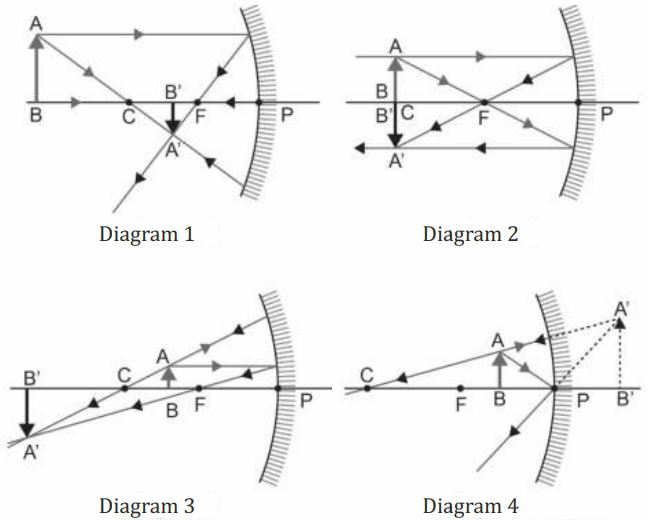
1. Which of these can be concluded from diagram 1?
A. Image is formed at the focus.
B. Size of the image is equal to the size of the object.
C. Distance between pole and centre of curvature is twice the focal length.
D. Distance between the image and focus is half the distance between the object and focus.
2. Which diagram shows a real, inverted and enlarged image formed by the mirror?
A. Diagram 1
B. Diagram 2
C. Diagram 3
D. Diagram 4
3. In which condition does a concave mirror produce a virtual image?
A. When object is located within the focal length
B. When object is located at the centre of curvature
C. When object is located in between ininity and the centre of curvature
D. When object is located in between the centre of curvature and the focus
4. Solar cookers contain a concave mirror.
How does the concave mirror help in heating the food?
Circle ‘Yes’ or ‘No’ for the correct response.
P is the pole or centre of the relecting surface of the mirror.
F is the focus of the mirror.
C is the centre of curvature of the mirror.
AB is the object and A’B’ is the image of the object.
1. Which of these can be concluded from diagram 1?
A. Image is formed at the focus.
B. Size of the image is equal to the size of the object.
C. Distance between pole and centre of curvature is twice the focal length.
D. Distance between the image and focus is half the distance between the object and focus.
2. Which diagram shows a real, inverted and enlarged image formed by the mirror?
A. Diagram 1
B. Diagram 2
C. Diagram 3
D. Diagram 4
3. In which condition does a concave mirror produce a virtual image?
A. When object is located within the focal length
B. When object is located at the centre of curvature
C. When object is located in between ininity and the centre of curvature
D. When object is located in between the centre of curvature and the focus
4. Solar cookers contain a concave mirror.
How does the concave mirror help in heating the food?
Circle ‘Yes’ or ‘No’ for the correct response.
| How does the concave mirror heat the food? | Yes or No |
| Sun’s rays are absorbed by the mirror. | Yes/No |
| Sun’s rays relected by the mirror converge at a point. | Yes/No |
| Sun’s rays diverge out when relected by the mirror. | Yes/No |
In 1827, a German physicist Georg Simon Ohm (1787-1854) found out the relationship between the current I, flowing in metallic wire and the potential difference across its terminals. He stated that the electric current flowing through a metallic wire is directly proportional to the potential difference V, across its ends provided its temperature remains the same.
The resistance of a circuit is defined as the ratio between the voltage applied to the current flowing through it. Rearranging the above relation,
$R=\frac{V}{I}$
Electric charge flows easily through some materials than others. The electrical resistance measures how much the flow of this electric charge is restricted within the circuit.
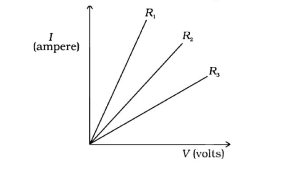
i. What is the unit of electrical resistance?
ii. Define Ohm's law.
iii. From graph which resistance have high resistance?
OR
What does the slope of V-I graph at any point represent?
→The resistance of a circuit is defined as the ratio between the voltage applied to the current flowing through it. Rearranging the above relation,
$R=\frac{V}{I}$
Electric charge flows easily through some materials than others. The electrical resistance measures how much the flow of this electric charge is restricted within the circuit.
i. What is the unit of electrical resistance?
ii. Define Ohm's law.
iii. From graph which resistance have high resistance?
OR
What does the slope of V-I graph at any point represent?
The picture shows an electric circuit.
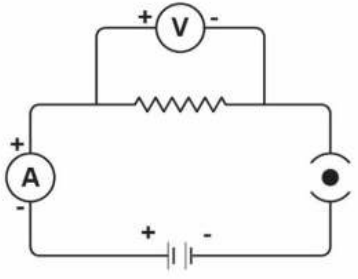
7. Which of these is true about the circuit?
Circle ‘Yes’ or ‘No’ for correct response.
8. Will there be any change in the ammeter reading if the length of the wire in the circuit is doubled?
Explain your answer.
7. Which of these is true about the circuit?
Circle ‘Yes’ or ‘No’ for correct response.
| Is this true for the circuit? | Yes or No |
| The circuit is open. | Yes/No |
| The circuit has double batteries. | Yes/No |
| The circuit has an ammeter and a voltmeter parallel to each other. | Yes/No |
Explain your answer.