Questions

case /data -based [Phy-4M]

🎯

Test yourself on this topic

8 questions · timed · auto-graded

Question 14 Marks
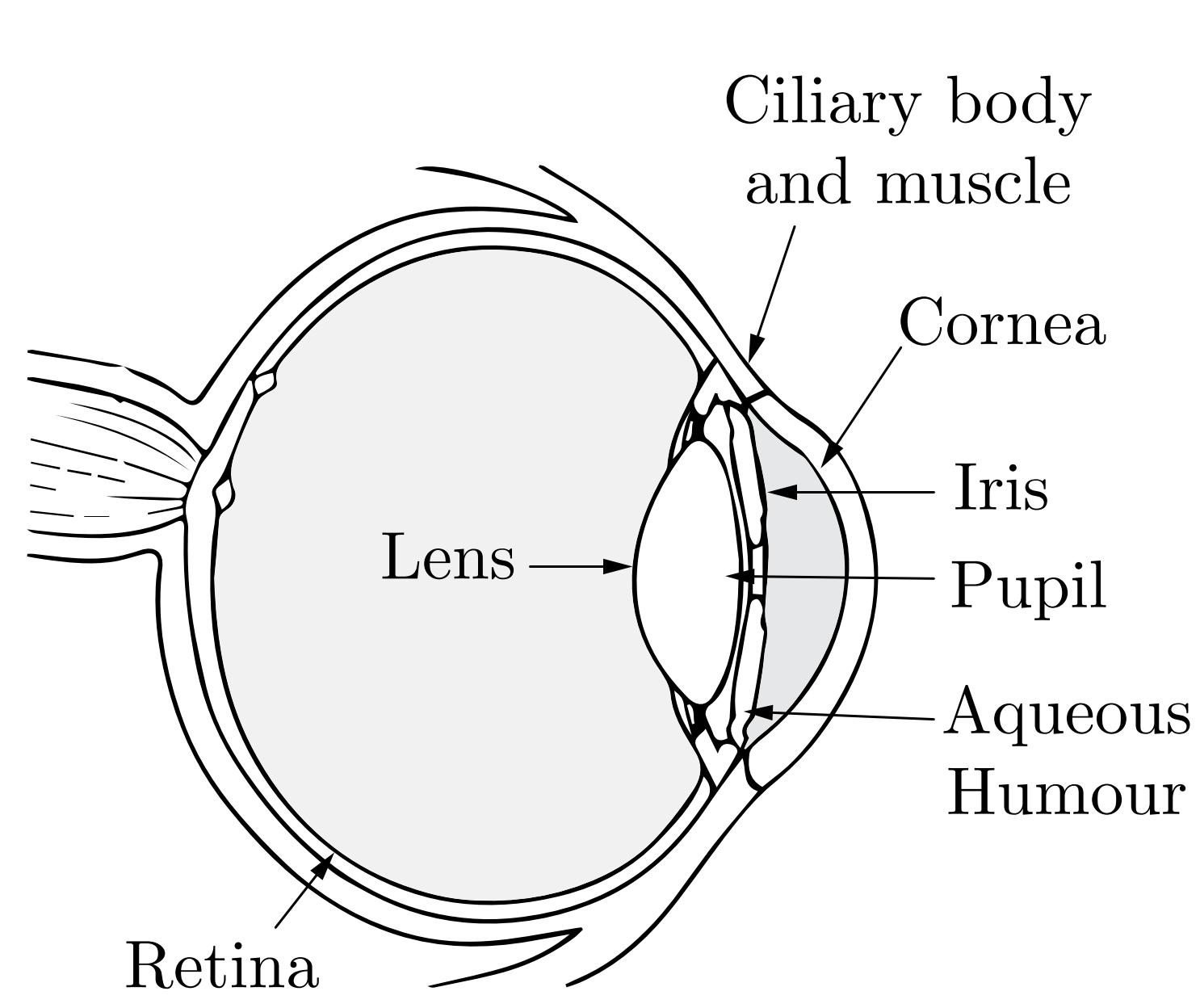
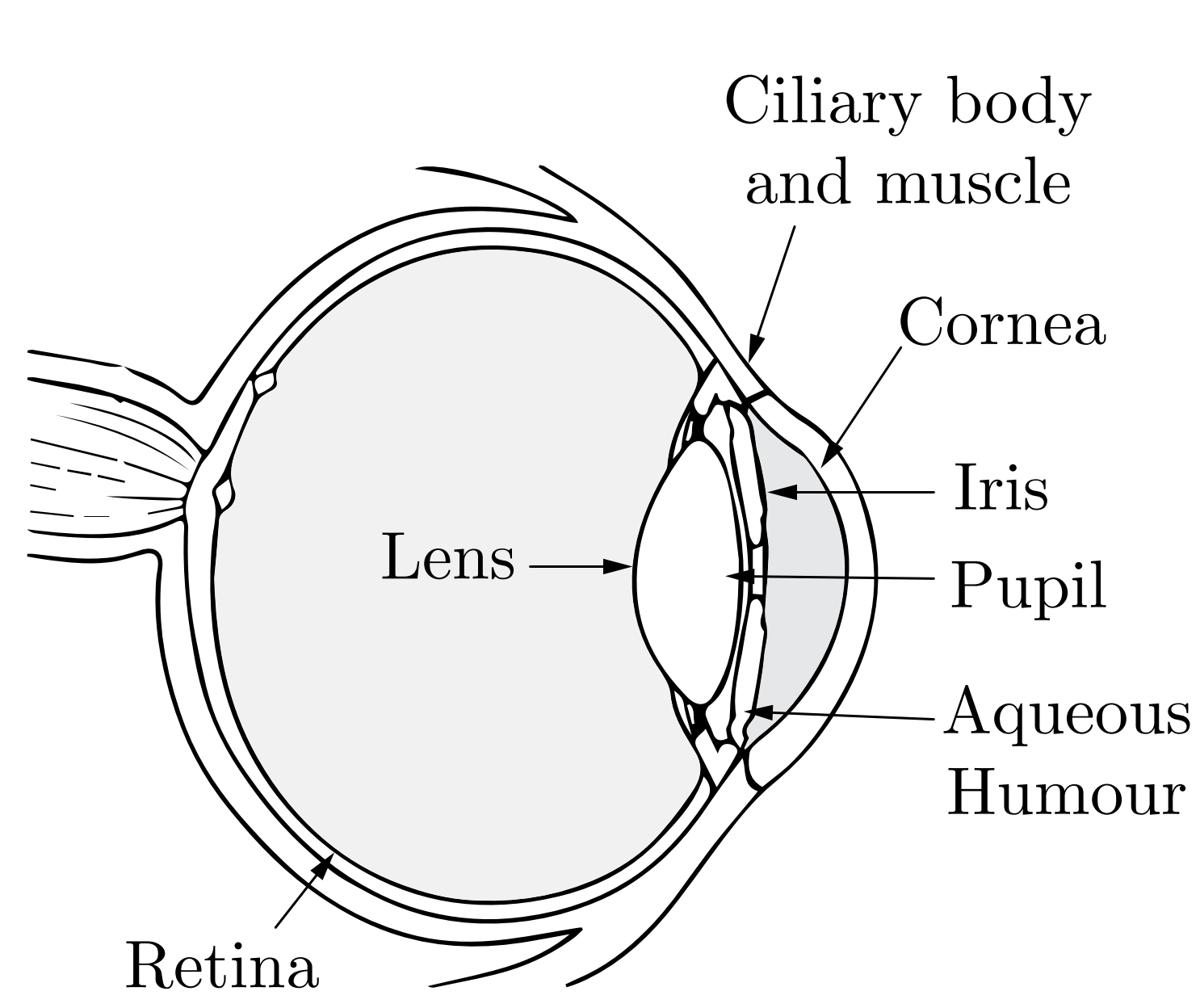
The lens of the eye does little of the bending of the light rays. Most of the refraction is done at the front surface of the cornea which also acts as a protective covering. The lens acts as a fine adjustment for focussing at different distances. This is accomplished by the ciliary muscle, which change the curvature of the lens so that its focal length is changed. To focus on a distant object, the muscles are relaxed and the lens is thin and parallel rays focus at the focal point (on the retina). To focus on a nearby object, the muscles contract, causing the centre of the lens to be thicker, thus shortening the focal length so that images of nearby objects can be focused on the retina, behind the focal point. This focusing adjustment is called accommodation.
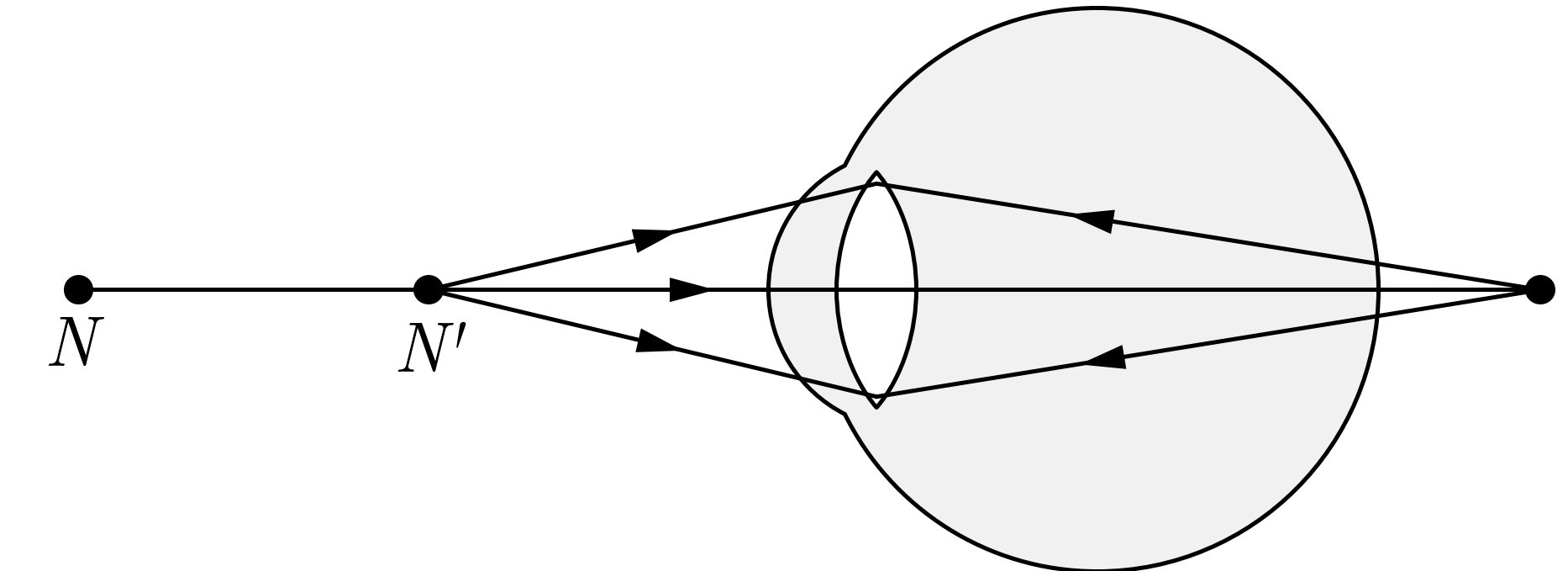
The closest distance at which the eye can focus clearly is called the near point of the eye. A given person's far point is the farthest distance at which an object can be seen clearly. To check your own near point, place this book close to your eye and slowly move it away until the type is sharp.
A large part of the population have eyes that do not accommodate within the normal range of $25 cm$ to infinity, or have some other defect. Two common defects are near-sightedness and far-sightedness. Both can be corrected to a large extent with lenses-either eyeglasses or contact lenses.
(i) The ciliary muscle muscles of a normal eye are in their (i). most relaxed (ii). most contracted state. In which of the two cases is the focal length of the eye-lens more?
(ii) What is the least distinct of vision of young man?
(iii) What is persistence of vision?
or
(iv) What is meant by power of accommodation of the eye?
Answer
(i) In most relaxed state
(iii) $25 cm$
(ii) The impression or sensation of the image remains on the retina for about $1 / 16^{\text {th }}$ of a second. It is called persistence of vision.
or
(iv) Power of accommodation is the ability of the eye lens to focus near and far objects clearly on the retina by adjusting its focal length.
View full question & answer
Question 24 Marks
Read the following and answer any three questions from (i) to (iv).

The spreading of light by the air molecules is called scattering of light. The light having least wavelength scatters more. The sun appears red at sunrise and sunset, appearance of blue sky it is due to the scattering of light. The colour of the scattered light depends on the size of particles. The smaller the molecules in the atmosphere scatter smaller wavelengths of tight. The amount of scattering of light depends on the wavelength of light. When light from sun enters the earth's atmosphere, it gets scattered by the dust particles and air molecules present in the atmosphere. The path of sunlight entering in the dark room through a fine hole is seen because of scattering of the sun light by the dust particles present in its path inside the room.

  1. To an astronaut in a spaceship, What colour of the earth appears?

  2. The colour of sky appears blue, it is due to?
  3. Define scattering of light? also write an example
                               OR.
  4. The danger signs made red in colour, why?
Answer
  1. (b) Blue.

Explanation:

Light is scattered by the air molecules present in atmosphere.

  1. (a) Longest distance of atmosphere.

Explanation:

As the distance between us and sun is more at the time of sunrise and sunset.

  1. (c) Scattering of light by air molecules.

Explanation:

Due to the more scattering of blue colour by molecules of air.

  1. (a) Blue colour scattered and red colour reaches our eye.

Explanation:

Red light being of largest wavelength blue scatter more, red scattered least.

  1. (c) Both (a) and (b).

Explanation:

Scattering is least but velocity of red light is more.

View full question & answer
Question 34 Marks
View full question & answer
Question 44 Marks
The ciliary muscle muscles of eye control the curvature of the lens in the eye and hence can alter the effective focal length of the system. When the muscles are fully relaxed, the focal length is maximum. When the muscles are strained the curvature of lens increases (that means radius of curvature decreases) and focal length decreases. For a clear vision the image must be on retina. The image distance is therefore fixed for clear vision and it equals the distance of retina from eye-lens. It is about $2.5 cm$ for a grown-up person. A person can theoretically have clear vision of objects situated at any large distance from the eye. The smallest distance at which a person can clearly see is related to minimum possible focal length, The ciliary muscles are most strained in this position. For an average grown-up person minimum distance of object should be around 25 cm. A person suffering for eye defects uses spectacles (Eye glass). The function of lens of spectacles is to form the image of the objects within the range in which person can see clearly. The image of the spectacle-lens becomes object for eye-lens and whose image is formed on retina. The number of spectacle-lens used for the remedy of eye defect is decided by the power of the lens required and the number of spectacle-lens is equal to the numerical value of the power of lens with sign. For example power of lens required is $+3 D$ (converging lens of focal length $100 / 3 cm$ ) then number of lens will be $+3$

For all the calculations required you can use the lens formula and lens maker's formula. Assume that the eye lens is equiconvex lens. Neglect the distance between eye lens and the spectacle lens.
(i) What do you mean by the ciliary muscles?
(ii) What is the minimum focal length of eye lens of a normal person ?
(iii) What is the maximum focal length of eye lens of normal person ?
or
(iv) A near-sighted man can clearly see object only up-to a distance of $100 cm$ and not beyond this. What is the number of the spectacles lens necessary for the remedy of this defect ?
Answer
COMING SOON
View full question & answer
Question 54 Marks
A person is suffering from hypermetropia (long sightedness). It is a defect in which a human eye can see far off object clearly, but is unable to see nearby object distinctly. The near point of the person is $1.5 m$. Assume that the near point of the normal eye is $25 cm$.

(i) What type of lens should be used in his spectacles?
(ii) What should be the focal length of the lens he used?
(iii) What will be the potver of the lens?
or
(iv) Write one possible cause of this defect.
Answer
(i) Convex lens is to be used in his spectacles.
(ii) Here,
\[\begin{aligned}d & =150 cm \\D & =25 cm \\v & =-150 cm \\u & =-25 cm\end{aligned}\]
Using lens formula,
\[\begin{aligned}\frac{1}{f} & =\frac{1}{v}-\frac{1}{u} \\& =\frac{1}{-150 cm }-\frac{1}{-25 cm } \\& =\frac{-1+6}{150 cm }=\frac{5}{150 cm } \\f & =30 cm\end{aligned}\]
(iii) Power of the lens,
\[P=\frac{100}{f} D =\frac{100}{30} D =3.3 D\]
or
(iv) Increase in focal length of the eye lens, when the eye is fully relaxed is the cause of hypermetropia.
View full question & answer
Question 64 Marks
A near sighted person wears eye glass with power of $-5.0$ D for distant vision. Soon, he started having difficulties in viewing nearby objects also. His doctor prescribes a correction of $+1.5 D$ in near vision section of his bi-focal, which is measured relative to main part of the lens.

(i) Find the focal length of his distant viewing part of lens.
(ii) Find the focal length of near vision section of the lens.
(iii) What type of lens is to be used in this spectacles for near vision?
or
(iv) What is the reason of hypermetropia?
Answer
COMING SOON
View full question & answer
Question 74 Marks
Answer
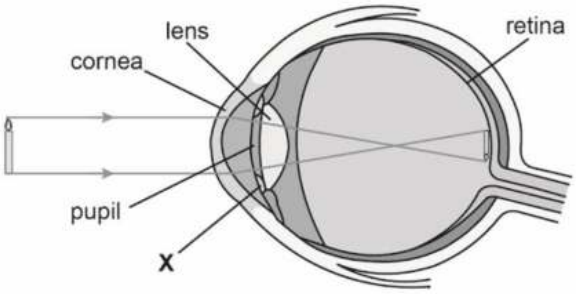
1. Mentions X is iris 
2. D. Cornea 
3. B. Real and inverted
4. D. Distance of the candle from the eyes
5. B. Image
6. Mentions iris as the response 
7. Mentions that ageing is the primary reason. For example,
● Old age
8. No
   Yes
   No
View full question & answer
Question 84 Marks
Answer
9. Yes
    No
    Yes
10. Mentions that the leaves absorb all colours and relect only the green colour to the eyes 
View full question & answer
case /data -based [Phy-4M] - Science STD 10 Questions - Vidyadip