MCQ
The image formed by a spherical mirror is virtual. The mirror will be:
  • A
    Concave.
  • B
    Convex.
  • C
    Either concave or convex.
  • D
    Metallic.

Answer

  1. Convex.

Explanation:

A convex mirror always forms a virtual image.

Need a full question paper?

Generate a complete, print-ready paper with questions like this in minutes — across 16+ boards, with answer keys.
Start Generating Free

Similar questions

After testing the eyes of a child, the optician has prescribed the following lenses for his spectacles:
Left eye: +2.00D
Right eye: +2.25D
The child is suffering from the defect of vision called:
  1. Short-sightedness.
  2. Long-sightedness.
  3. Cataract.
  4. Presbyopia.
The animals of prey have:
  1. Two eyes at the front.
  2. Two eyes at the back.
  3. Two eyes on the sides.
  4. One eye at the front and one on the side.
At a given time, a house is supplied with 100A at 220V. How many 75W, 220V light bulb could be switched on in the house at the same time (if they are all connected in parallel)?
  1. 93
  2. 193
  3. 293
  4. 393
Which of the following statements correctly defines a volt?
  1. A volt is a joule per ampere.
  2. A volt is a joule per coulomb.
A coil in the heater consume power P on passing current. If it is cut into halves and joined in parallel, it will consume power:
A battery of 10 volt carries 20,000C of charge through a resistance of 20 Ω. The work done in 10 seconds is:
The refractive index of glass with respect to air is $\frac{3}{2}$ and the refractive index of water with respect to air is $\frac{4}{3}.$ The refractive index of glass with respect to water will be:
  1. 1.525
  2. 1.225
  3. 1.425
  4. 1.125 
When an electric lamp is connected to 12V battery, it draws a current of 0.5A. The Power of the lamp is:
  1. 0.5W.
  2. 6W.
  3. 12W.
  4. 24W.
n order to obtain a magnification of, −0.6 (minus 0.6) with a concave mirror, the object must be placed:
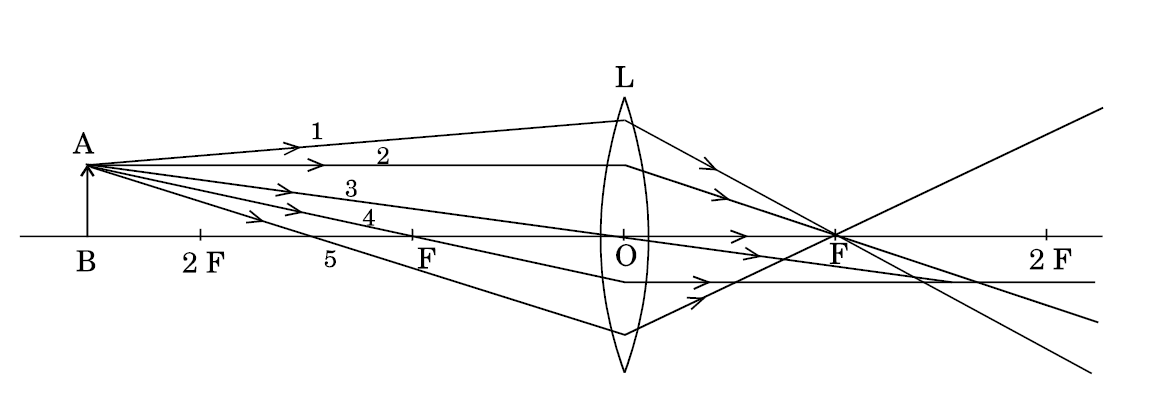
A student is using a convex lens of focal length 18 cm to study the image formation by it for the various positions of the object. He observes that when he places the object at 27 cm, the location of the image is at 54 cm on the other side of the lens. Identify from the following diagram the three rays that are obeying the laws of refraction and may be used to draw the corresponding ray diagram.