MCQ
The incorrect statement regarding $15^{th}$ group hydrides $(EH_3)$ . $[E = N, P, As, Sb, Bi]$
  • A
    $NH_3 > PH_ 3 > AsH_ 3 > SbH_ 3 > BiH_ 3 :$ Thermal stability
  • B
    $N-H > P-H > As-H > Sb-H > Bi-H : E-H$ bond dissociation enthalpy
  • $NH_3 > PH_3 > AsH_3 > SbH_3 > BiH_3 :$ Reducing character
  • D
    $NH_3 > PH_3 > AsH_3 > SbH_3 > BiH_3 :$ Basicity

Answer

Correct option: C.
$NH_3 > PH_3 > AsH_3 > SbH_3 > BiH_3 :$ Reducing character
c
${\text{Reducing character}} \propto \frac{1}{{'E - H'\,bond\,dissociation\,enthalpy}}$

Hence, correct reducing character is $NH_3 < PH_3 < AsH_3 < SbH_3 < BiH_3$

Need a full question paper?

Generate a complete, print-ready paper with questions like this in minutes — across 16+ boards, with answer keys.

Start Generating Free

Similar questions

${C_6}{H_5}N{H_2}\xrightarrow[{0 - {5\,^o}C}]{{{\text{HC}}l + NaN{O_2}}}A\xrightarrow{{CuCN}}B\xrightarrow{{{H_2}/Ni}}C\xrightarrow{{HN{O_2}}}D$

The structure of $D$ is

$IUPAC$ name of the below is :
Standard free energies of formation (in $kJ/mol$) at $298\, K$ are $-237.2, -394.4$ and $-8.2 $ for $H_2O_{(l)} , CO_{2(g)}$ and pentane$_{(g)}$ respectively. The value of $E^o_{cell}$ for the pentane-oxygen fuel cell is .......... $V$.
The $pH$ at which $\mathrm{Mg}(\mathrm{OH})_2\left[\mathrm{~K}_{\mathrm{sp}}=1 \times 10^{-11}\right]$ begins to precipitate from a solution containing $0.10 \ \mathrm{M}$ $\mathrm{Mg}^{2+}$ ions is_____
Which of the following order is correct ?
Which type of the overlap of orbitals involves in hyperconjugation ?
Among the following molecules which one have smallest bond angle
The hydrolysis of an ester was carried out separately with $0.1\ N$ $HCl$ and $0.1\ N$ $H_2SO_4$ . Then for rate of reaction $(R)$ in the presence of acid which of the following relation is true
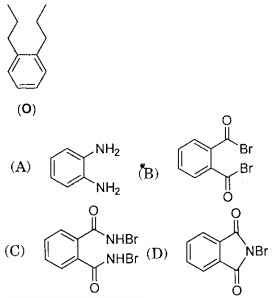
Treatment of compound $O$ with $KMnO_4 / \mathrm{H}^{+}$gave $P$, which on heating with ammonia gave $Q$. The compound $Q$ on treatment with $Br_2 / NaOH$ produced $R$. On strong heating, $Q$ gave $S$, which on further treatment with ethyl $2$-bromopropanoate in the presence of $KOH$ followed by acidification, gave a compound $T$.

(image)

($1$) The compound $R$ is

(image)

($2$) The compound $T$ is

($A$) glycine

($B$) alanine

($C$) valine

($D$) serine

Given the answer question ($1$) and ($2$) 

The hydration of propyne results in formation of