The intensity of electric field at a point between the plates of a charged capacitor
Easy
Download our app for free and get started
(d) Electric field between the plates of parallel plate capacitor is uniform and it doesn't depend upon distance.

Download our appand get started for free
Experience the future of education. Simply download our apps or reach out to us for more information. Let's shape the future of learning together!No signup needed.*
Similar Questions
- 1Three point charges $Q, 4Q $ and $16Q $ are placed on a straight line $9$ $cm$ long. Charges are placed in such a way that the system has minimum potential energy. ThenView Solution
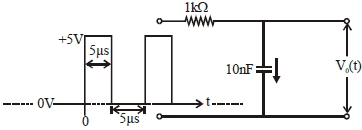
- 2For the given input voltage waveform $V_{\text {in }}( t )$, the output voltage waveform $V _{ D }( t ),$ across the capacitor is correctly depicted by:View Solution
- 3The electric field near a conducting surface having a uniform surface charge density $\sigma $ is given byView Solution
- 4For changing the capacitance of a given parallel plate capacitor, a dielectric material of dielectric constant $K$ is used, which has the same area as the plates of the capacitor. The thickness of the dielectric slab is $\frac{3}{4} d$, where $'d'$ is the separation between the plates of parallel plate capacitor. The new capacitance $(C')$ in terms of original capacitance $\left( C _{0}\right)$ is given by the following relationView Solution
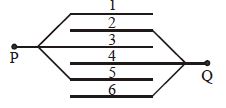
- 5Six metallic plates each with a surface area of one side $A$, are placed at a distance $d$ from each other. The alternate plates are connected to points $P$ and $Q$ as shown in figure. The capacitance of the system isView Solution
- 6View SolutionAfter charging a capacitor the battery is removed. Now by placing a dielectric slab between the plates :-
- 7Two charges $ + 3.2 \times {10^{ - 19}}\,C$ and $ - 3.2 \times {10^{ - 19}}\,C$ kept $2.4\, \mathop A\limits^o $ apart forms a dipole. If it is kept in uniform electric field of intensity $4 \times {10^5}\,volt/m$ then what will be its electrical energy in equilibriumView Solution
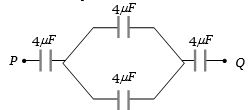
- 8Four condensers each of capacity $4\,\mu F$ are connected as shown in figure. ${V_P} - {V_Q} = 15\,volts$. The energy stored in the system is......$ergs$View Solution
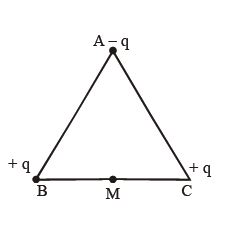
- 9Charges $-q,\, q,\,q$ are placed at the vertices $A$, $B$, $C$ respectively of an equilateral triangle of side $'a'$ as shown in the figure. If charge $-q$ is released keeping remaining two charges fixed, then the kinetic energy of charge $(-q)$ at the instant when it passes through the mid point $M$ of side $BC$ isView Solution
- 10Twenty seven drops of same size are charged at $220\, \mathrm{~V}$ each. They combine to form a bigger drop. Calculate the potential of the bigger drop. (In $\mathrm{~V}$)View Solution