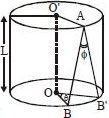
The upper end of a wire $1\,m$ long and $4\,mm$ radius is clamped. The lower end is twisted by an angle of $30^o$. The angle of shear is ...... $^o$
Diffcult


Download our appand get started for free
Experience the future of education. Simply download our apps or reach out to us for more information. Let's shape the future of learning together!No signup needed.*
Similar Questions
- 1View SolutionBulk modulus was first defined by
- 2A solid sphere of radius $r$ made of a soft material of bulk modulus $K$ is surrounded by a liquid in a cylindrical container. A massless piston of area $a$ floats on the surface of the liquid, covering entire crosssection of cylindrical container. When a mass $m$ is placed on the surface of the piston to compress the liquid, the fractional decrement in the radius of the sphere, $\left( {\frac{{dr}}{r}} \right)$ isView Solution
- 3The proportional limit of steel is $8 \times 10^8 \,N / m ^2$ and its Young's modulus is $2 \times 10^{11} \,N / m ^2$. The maximum elongation, a one metre long steel wire can be given without exceeding the elastic limit is $......mm$View Solution
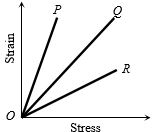
- 4The strain-stress curves of three wires of different materials are shown in the figure. $P, Q$ and $R$ are the elastic limits of the wires. The figure shows thatView Solution
- 5Copper of fixed volume $V$ is drawn into wire of length $l$. When this wire is subjected to a constant force $F$, the extension produced in the wire is $\Delta l$. Which of the following graphs is a straight line?View Solution
- 6Two wires $A$ and $B $ of same length and of the same material have the respective radii ${r_1}$ and ${r_2}$. Their one end is fixed with a rigid support, and at the other end equal twisting couple is applied. Then the ratio of the angle of twist at the end of $A$ and the angle of twist at the end of $B $ will beView Solution
- 7A cube of aluminium of sides $0.1\, m$ is subjected to a shearing force of $100\, N$. The top face of the cube is displaced through $0.02 \,cm$ with respect to the bottom face. The shearing strain would beView Solution
- 8The ratio of radii of two wires of same material is $2: 1$. If these wires are stretched by equal force, the ratio of stresses produced in them is $.............$View Solution
- 9Under the same load, wire $A$ having length $5.0\,m$ and cross section $2.5 \times 10^{-5}\,m ^2$ stretches uniformly by the same amount as another wire $B$ of length $6.0\,m$ and a cross section of $3.0 \times 10^{-5}\,m ^2$ stretches. The ratio of the Young's modulus of wire $A$ to that of wire $B$ will beView Solution
- 10View SolutionA beam of metal supported at the two ends is loaded at the centre. The depression at the centre is proportional to