Question
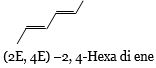
The $IUPAC$ name of compound is

Answer

d
(d) If atom or group of higher priority are on opposite direction at the double bond of each carbon atom then the configuration is known as $E$ and if they are in same direction then the configuration is known as $Z$ configuration.

Need a full question paper?

Generate a complete, print-ready paper with questions like this in minutes — across 16+ boards, with answer keys.

Start Generating Free

Similar questions

Among the following molecule highest dipole moment is
Solid methane is
The $V-C$ distance in $V(CO)_6$ and $[V(CO)_6]^-$ are respectively (in $pm$)-
$\begin{array}{*{20}{c}}
  {C{H_2} = CHCHC{H_2}C{H_2}OH} \\ 
  |\,\,\,\, \\ 
  {OH\,\,\,} 
\end{array}$ $\xrightarrow{{Mn{O_2}}}A.$

$A$ is

Two elements $A$ and $B$ which form $0.15\,moles$ of $A _{2} B$ and $AB _{3}$ type compounds. If both $A _{2} B$ and $A B_{3}$ weigh equally, then the atomic weight of $A$ is $....$ times of atomic weight of $B$.
The oxidation potential of a hydrogen electrode at $pH\, = 10$ and ${P_{{H_2}}}\,= 1$ $atm$ will be ............ $\mathrm{V}$
When $100 \ mL$ of $1.0 \ M \ HCl$ was mixed with $100 \ mL$ of $1.0 \ M \ NaOH$ in an insulated beaker at constant pressure, a temperature increase of $5.7^{\circ} C$ was measured for the beaker and its contents (Expt. $1$). Because the enthalpy of neutralization of a strong acid with a strong base is a constant $\left(-57.0 \ kJ \ mol ^{-1}\right)$, this experiment could be used to measure the calorimeter constant. In a second experiment (Expt. $2$), $100 \ mL$ of $2.0 \ M$ acetic acid $\left(K_a=2.0 \times 10^{-5}\right)$ was mixed with $100 \ mL$ of $1.0 M \ NaOH$ (under identical conditions to Expt. $1$) where a temperature rise of $5.6^{\circ} C$ was measured.

(Consider heat capacity of all solutions as $4.2 J g ^{-1} K ^{-1}$ and density of all solutions as $1.0 \ g mL ^{-1}$ )

$1.$ Enthalpy of dissociation (in $kJ mol ^{-1}$ ) of acetic acid obtained from the Expt. $2$ is

$(A)$ $1.0$ $(B)$ $10.0$ $(C)$ $24.5$ $(D)$ $51.4$

$2.$ The $pH$ of the solution after Expt. $2$ is

$(A)$ $2.8$ $(B)$ $4.7$ $(C)$ $5.0$ $(D)$ $7.0$

Give the answer question $1$ and $2.$

The $IUPAC$ name for the complex $[Co(NH_3)_5 (NO_2)]Cl_2$ is
The $IUPAC$ name of 

$\begin{array}{*{20}{c}}
  {{{\left( {{C_2}{H_5}} \right)}_2}NC{H_2}CH \cdot COOH} \\ 
  {\,\,\,\,\,\,\,|} \\ 
  {\,\,\,\,\,\,\,Cl} 
\end{array}$

is :

An ion $M^{2+},$ forms the complexes $[M(H_2O)_6]^{2+} , [M(en)_3]^{2+}$ and $[MBr_6]^{4-},$ match the complex with the appropriate colour.