Question
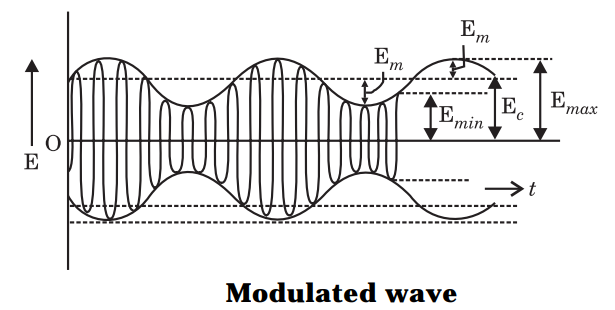
What do you mean by modulation ? Define modulation index. For an amplitude modulated wave the maximum and minimum amplitude is ' $a$ ' and ' $b$ '. Calculate modulation index for it.

Need a full question paper?

Generate a complete, print-ready paper with questions like this in minutes — across 16+ boards, with answer keys.
Start Generating Free

Similar questions

In a series RC circuit with an AC source, $\text{R}=300\Omega,\text{C}=25\mu\text{F},\epsilon_0=50\text{V}$ and $\nu=\frac{50}{\pi}\text{Hz}.$ Find the peak current and the average power dissipated in the circuit.
A glass surface is coated by an oil film of uniform thickness $1.00 \times 10^{-4}cm.$ The index of refraction of the oil is $1.25$ and that of the glass is $1.50.$ Find the wavelengths of light in the visible region $(400\ nm - 750\ nm)$ which are completely transmitted by the oil film under normal incidence.
A load resistor of $2\text{k}\Omega$ is connected in the collector branch of an amplifier circuit using a transistor in common-emitter mode. The current gain $\beta=50.$ The input resistance of the transistor is $0.50\text{k}\Omega.$ If the input current is changed by $50\mu\text{A}.$
  1. By what amount does the output voltage change?
  2. By what amount does the input voltage change?
  3. What is the power gain?
How many time constants will elapse before the energy stored in the capacitor reaches half of its equilibrium value in a charging RC circuit?
A beam of monochromatic light of wavelength $\lambda$ ejects photoelectrons from a cesium surface $\big(\Phi=1.9\text{eV}\big).$ These photoelectrons are made to collide with hydrogen atoms in ground state. Find the maximum value of $\lambda$ for which (a) hydrogen atoms may be ionized, (b) hydrogen atoms may get excited from the ground state to the first excited state and (c) the excited hydrogen atoms may emit visible light.
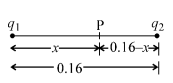
Two charges of$5 \times 10^{-8} C$ and $-3 \times 10^{-8}$ are located at a distance of 16 cm apart. At what point on the line joining the two charges is the electric potential zero? Take the potential at infinity to be zero.
Image
Draw a neat and labelled diagram of a cyclotron. State the underlying principle and explain how a positively charged particle gets accelerated in this machine. Show mathematically that the cyclotron frequency does not depend upon the speed of the particle.
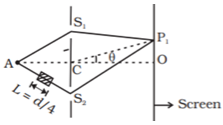
A small transparent slab containing material of $\mu=1.5$ is placed along $AS _2 $$Figure$)$. What will be the distance from $O$ of the principal maxima and of the first minima on either side of the principal maxima obtained in the absence of the glass slab?
Image

$AC = CO = D , S _1 C = S _2 C = d < D$
A hydrogen atom moving at speed $υ$ collides with another hydrogen atom kept at rest. Find the minimum value of $υ$ for which one of the atoms may get ionized. The mass of a hydrogen atom $= 1.67 \times 10^{-27}kg.$
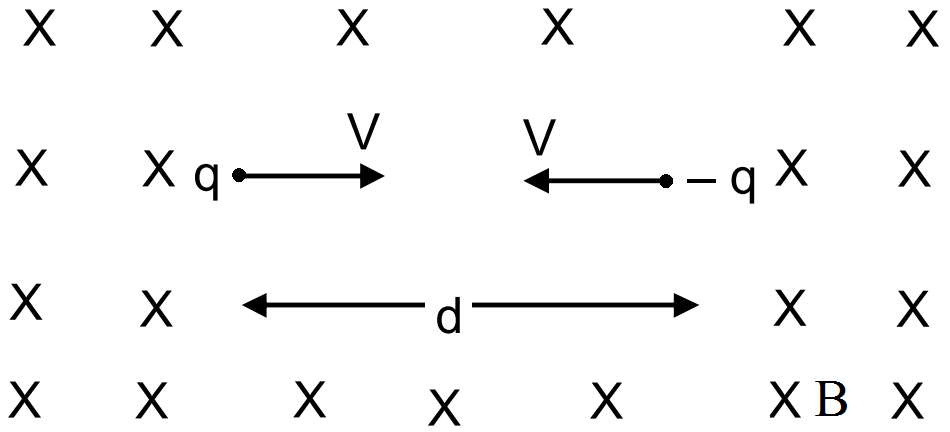
Two particles, each with mass $m$ are placed at a separation $d$ in a uniform magnetic field $B,$ as shown in the figure. They have opposite charges of equal magnitude $q$. At time $t = 0,$ the particles are projected towards each other, each with a speed $v$. Suppose the Coulomb force between the charges is switched off.
  1. Find the maximum value $v_m$ of the projection speed, so that the two particles do not collide.
  2. What would be the minimum and maximum separation between the particles if $\text{v}=\text{v}_{\text{m}}\sqrt{2}?$
  3. At what instant will a collision occur between the particles if $v = 2v_m$ ?
  4. Suppose $v = 2v_m$ and the collision between the particles is completely inelastic. Describe the motion after the collision.