MCQ
The kinetic energy of a particle executing $S.H.M.$ is $16\, J$ when it is in its mean position. If the amplitude of oscillations is $25\, cm$ and the mass of the particle is $5.12\, kg$, the time period of its oscillation is
  • $\frac{\pi }{5}\,sec$
  • B
    $2\pi \,sec$
  • C
    $20\pi \,sec$
  • D
    $5\pi \,sec$

Answer

Correct option: A.
$\frac{\pi }{5}\,sec$
a
(a) At mean position, the kinetic energy is maximum.
Hence $\frac{1}{2}m{a^2}{\omega ^2} = 16$
On putting the values we get $\omega = 10\; \Rightarrow \;T = \frac{{2\pi }}{\omega } = \frac{\pi }{5}\sec $

Need a full question paper?

Generate a complete, print-ready paper with questions like this in minutes — across 16+ boards, with answer keys.

Start Generating Free

Similar questions

A particle is moving along the $x-$axis with its coordinate with the time '$t$' given be $\mathrm{x}(\mathrm{t})=10+8 \mathrm{t}-3 \mathrm{t}^{2} .$ Another particle is moving the $y-$axis with its coordinate as a function of time given by $\mathrm{y}(\mathrm{t})=5-8 \mathrm{t}^{3} .$ At $\mathrm{t}=1\; \mathrm{s},$ the speed of the second particle as measured in the frame of the first particle is given as $\sqrt{\mathrm{v}} .$ Then $\mathrm{v}$ (in $\mathrm{m} / \mathrm{s})$ is
Imagine earth to be a solid sphece of mass $M$ and radius $R$. If the value of acceleration due to gravity at a depth d below earth's surface is same as its value at a height $h$ above its surface and equal to $\frac{g}{4}$ (where $g$ is the value of acceleration due to gravity on the surface of earth), the ratio of $\frac{h}{d}$ will be
The atmospheric pressure at a place is $10^5 \,Pa$. If tribromomethane (specific gravity $=2.9$ ) be employed as the barometric liquid, the barometric height is .......... $m$
A bob of mass $m$ attached to an inextensible string of length $l$ is suspended from a vertical support. The bob rotates in a horizontal circle with an angular speed $\omega\ rad/s$ about the vertical. About the point of suspension:
A particle moves in a circular path of radius $r$ with speed $v.$ It then increases its speed to $2\,v$ while travelling along the same circular path. The centripetal acceleration of the particle has changed by a factor of
Two sound waves of wavelengths $5m$ and $6m$ formed $30$ beats in $3$ seconds. The velocity of sound is  .... $ms^{-1}$
Two identical metal balls at temperature ${200^o}C$and ${400^o}C$ kept in air at ${27^o}C$. The ratio of net heat loss by these bodies is
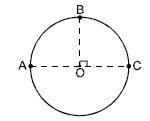
Three particle $A, B$ and $C$ move in a circle of radius $r = \frac{1}{\pi }\,m$, in anticlockwise direction with speeds $1\, m/s$, $2. 5\, m/s$ and $2\, m/s$ respectively. The initial positions of $A, B$ and $C$ are as shown in figure. The ratio of distance travelled by $B$ and $C$ by the instant $A, B$ and $C$ meet for the first time is
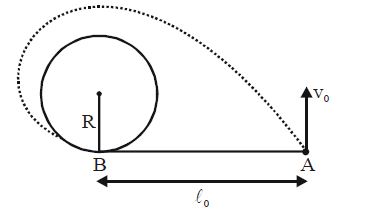
A horizontal plane supports a stationary vertical cylinder of radius $R = 1\ m$ and a disc $A$ attached to the cylinder by a horizontal thread $AB$ of length $l_0 = 2\ m$ (seen in figure, top view). An intial velocity ($v_0 = 1\ m/s$) is imparted $AB$ to the disc as shown in figure. .......... $\sec$ long will it move along the plane until it strikes against the cylinder ? (All surface are assumed to be smooth)
Intensity level of a sound of intensity $I$ is $30\, dB$. The ratio $\frac{I}{{{I_0}}}$ is (Where ${I_0}$ is the threshold of hearing)