Question
Because to the space charge in a diode valve:
  1. The plate current decreases.
  2. The plate voltage increases.
  3. The rate of emission of thermions increases.
  4. The saturation current increases.

Answer

  1. The plate current decreases.
Explanation:

A diode valve consists of a negatively-charged region between the cathode and anode, called the space charge region. This negatively-charged region repels the electrons coming from the cathode and, thus, it reduces the plate current. On the other hand, this region has no effect on plate voltage, rate of emission of thermions and the saturation current.

Need a full question paper?

Generate a complete, print-ready paper with questions like this in minutes — across 16+ boards, with answer keys.

Start Generating Free

Similar questions

Read the passage given below and answer the following questions from 1 to 5. Moment of Inertia A heavy wheel called flywheel is attached to the shaft of steam engine, automobile engine etc., because of its large moment of inertia, the flywheel opposes the sudden increase or decrease of the speed of the vehicle. It allows a gradual change in the speed and prevents jerky motion and hence ensure smooth ride of passengers.
  1. Moment of inertia of a body depends upon:
  1. axis of rotation
  2. torque
  3. angular momentum
  4. angular velocity
  1. A particle of mass 1 kg is kept at (1m, 1m, 1m). The moment of inertia of this particle about Z-axis would be:
  1. $1 kg-m^2$
  2. $2 kg-m^2$
  3. $3 kg-m^2$
  4. (None of the above)
  1. Moment of inertia of a rod of mass m and length l about its one end is I. If one-fourth of its length is cut away, then moment of inertia of the remaining rod about its one end will be:
  1. $\frac{3}{4}\text{I}$
  2. $\frac{9}{16}\text{I}$
  3. $\frac{27}{64}\text{I}$
  4. $\frac{\text{I}}{16}$
  1. A circular disc is to be made by using iron and aluminium, so that it acquires maximum moment of inertia about its geometrical axis. It is possible with:
  1. iron and aluminium layers in alternate order
  2. aluminium at interior and iron surrounding it
  3. iron at interior and aluminium surrounding it
  4. Either (a) or (c)
  1. Three thin rods each of length L and mass M are placed along X ,Y and Z -axes such that one end of each rod is at origin. The moment of inertia of this system about Z-axis is:
  1. $\frac{2}{3}\text{ML}^2$
  2. $\frac{4\text{ML}^2}{3}$
  3. $\frac{5\text{ML}^2}{3}$
  4. $\frac{\text{ML}^2}{3}$
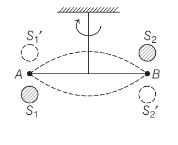
Read the passage given below and answer the following questions from 1 to 5. Cavendish’s Experiment The figure shows the schematic drawing of Cavendish’s experiment to determine the value of the gravitational constant. The bar AB has two small lead spheres attached at its ends. The bar is suspended from a rigid support by a fine wire. Two large lead spheres are brought close to the small ones but on opposite sides as shown. The value of G from this experiment came to be $6.67\times10^{-11}\frac{\text{N-m}^2}{\text{Kg}^2}$
  1. The big spheres attract the nearby small ones by a force which is:
  1. equal and opposite
  2. equal but in same direction
  3. unequal and opposite
  4. None of the above
  1. The net force on the bar is:
  1. non-zero
  2. zero
  3. Data insufficient
  4. None of these
  1. The net torque on the bar is:
  1. zero
  2. non-zero
  3. F times the length of the bar, where F is the force of attraction between a big sphere and its neighbouring
  4. Both (b) and (c)
  1. The torque produces twist in the suspended wire. The twisting stops when:
  1. restoring torque of the wire equals the gravitational torque
  2. restoring torque of the wire exceeds the gravitational torque
  3. the gravitational torque exceeds the restoring torque of the wire
  4. None of the above
  1. After Cavendish’s experiment, there have been given suggestions that the value of the gravitational constant G becomes smaller when considered over very large time period (in billions of years) in the future. If that happens, for our earth:
  1. nothing will change
  2. we will become hotter after billions of years
  3. we will be going around but not strictly in closed orbits
  4. None of the above
A diode value is connected to a battery and a load resistance. The filament is heated, so that a constant current is obtained in the circuit. As the cathode continuously emits electrons, does it become more and more positively charged?
A deflection magnetometer is placed with its arms in north-south direction. How and where should a short magnet having $\frac{\text{M}}{\text{B}_\text{H}}=40\text{A-m}^2\text{T}$ be placed so that the needle can stay in any position?
The gain factor of an amplifier in increased from 10 to 12 as the load resistance is changed from $4\text{k}\Omega\text{ to }8\text{k}\Omega$ Calculate (a) the amplification factor and (b) the plate resistance.
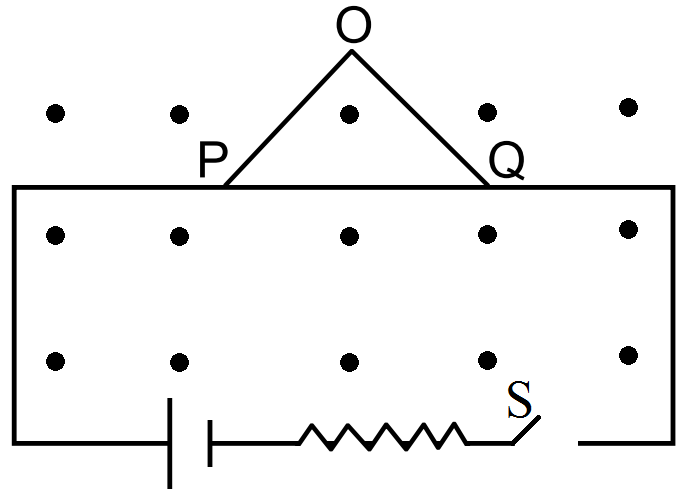
Shows a rod PQ of length 20.0cm and mass 200g suspended through a fixed point O by two threads of lengths 20.0cm each. A magnetic field of strength 0.500T exists in the vicinity of the wire PQ, as shown in the figure. The wires connecting PQ with the battery are loose and exert no force on PQ.
  1. Find the tension in the threads when the switch S is open.
  2. A current of 2.0A is established when the switch S is closed. Find the tension in the threads now.
The magnetic field due to the earth has a horizontal component of $26\mu\text{T}$ at a place where the dip is 60°. Find the vertical component and the magnitude of the field.
Read the passage given below and answer the following questions from $i$ to $v.$ When an object follows a circular path at a constant speed, the motion of the object is called uniform circular motion. The word “uniform” refers to the speed, which is uniform (constant) throughout the motion. Suppose an object is moving with uniform speed $v$ in a circle of radius $R$ Since the velocity of the object is changing continuously in direction, the object undergoes acceleration. Let us find the magnitude and the direction of this acceleration. Thus, the acceleration of an object moving with speed v in a circle of radius $R$ has a magnitude $V^2/R$ and is always directed towards the centre. This is why this acceleration is called centripetal acceleration (a term proposed by Newton). A thorough analysis of centripetal acceleration was first published in $1673$ by the Dutch scientist Christiaan Huygens $(1629-1695)$ but it was probably known to Newton also some years earlier. “Centripetal” comes from a Greek term which means ‘centre-seeking’. Since $v$ and $R$ are constant, the magnitude of the centripetal acceleration is also constant. However, the direction changes pointing always towards the centre. Therefore, a centripetal acceleration is not a constant vector. We can express centripetal acceleration ac in terms of angular speed as $\text{a}_\text{c}=\omega^2\text{R}$ The time taken by an object to make one revolution is known as its time period T and the number of revolution made in one second is called its frequency $v (=1/T).$ However, during this time the distance moved by the object is $\text{s}=2\pi\text{R}.$ Therefore, $\text{v}=2\pi\frac{\text{R}}{\text{T}}=2\pi\text{ Rv}$ In terms of frequency n, we have $\omega=2\pi\text{v}$
$\text{V}=2\pi\text{ RV}$
$\text{ac}=4\pi^2\text{v}^2\text{R}$
  1. SI unit of angular velocity is
  1. Rev/ sec
  2. $m/ s$
  3. $m/ s^2$ 
  4. None of these
  1. A centripetal acceleration is not a constant vector. True or false?
  1. True
  2. False
  1. Define Uniform circular motion
  2. What is meaning of word centripetal?
  3. What is centripetal acceleration? Give its relation with angular velocity
Cathode rays constitute a stream of:
  1. Electrons.
  2. Protons.
  3. Positive ions.
  4. Negative ions.
Read the passage given below and answer the following questions from 1 to 5.
Beats is an interesting phenomenon arising from interference of waves. When two harmonic Sound waves of slightly different frequencies and comparable amplitude are heard at the same time, we hear a sound of similar frequency (the average of two close frequencies), but we hear something else also. We hear audibly distinct waxing and waning of the intensity of the sound, with a frequency equal to the difference in the two close frequencies. Beat frequency is given by
$u = u_1 - u_2$
Artists use this phenomenon often while tuning their instruments with each other. They go on tuning until their sensitive ears do not detect any beats.
Doppler Effect is a wave phenomenon, it holds not only for sound waves but also for electromagnetic waves. However, here we shall consider only sound waves. Doppler Effect is defined as increase or decrease in frequency of sound due to relative motion between source of sound and observer. Frequency increases when source and observer comes towards each other and frequency decreases when source and observer go away from each other .For sound the observed frequency n is given in terms of the source frequency $v_0$ by
$\text{u}=\text{v}_0\frac{\text{v}+\text{v}_0}{\text{v}+\text{vs}}$
Here v is the speed of sound through the medium, is the velocity of observer relative to the medium, and is the source velocity relative to the medium. In using this formula, velocities in the direction OS should be treated as positive and those opposite to it should be taken to be negative. The change in frequency caused by a moving object due to Doppler Effect is used to measure their velocities in diverse areas such as military, medical science, astrophysics, etc. It is also used by police to check over-speeding of vehicles. A sound wave or electromagnetic wave of known frequency is sent towards a moving object. Some part of the wave is reflected from the object and its frequency is detected by the monitoring station. This change in frequency is called Doppler shift. It is used at airports to guide aircraft, and in the military to detect enemy aircraft. Astrophysicists use it to measure the velocities of stars. Doctors use it to study heart beats and blood flow in different parts of the body. Here they use ultrasonic waves, and in common practice, it is called sonography. Ultrasonic waves enter the body of the person, some of them are reflected back, and give information about motion of blood and pulsation of heart valves, as well as pulsation of the heart of the foetus. In the case of heart, the picture generated is called echocardiogram. Answer the following
  1. Beats are heard after superposition of two waves with beat frequency.
  1. $υ = υ_1 - υ_2$
  2. $υ = υ_1 + υ_2$
  3. $υ = (υ_1 - υ_2)/_2$
  4. None of these
  1. When source and observer comes towards each other then frequency heard will.
  1. Increase
  2. Decrease
  3. Remains same
  4. None of these
  1. Define beats.
  1. Define Doppler effect in sound.
  1. Note on applications of Doppler Effect in sound.