MCQ
The kinetic energy of translation of the molecules in 50 g of $\mathrm{CO}_{2}$ gas at $17^{\circ} \mathrm{C}$ is :
  • A
    3986.3 J
  • B
    4102.8 J
  • C
    4205.5 J
  • D
    3582.7 J

Answer

B.
$(\mathrm{KE})_{\text {Translational }}=\left[\frac{3}{2} \mathrm{KT}\right] \times$ no. of molecule
No. of molecule $=\left[\frac{50}{44} \times 6.023 \times 10^{23}\right]$
$(\mathrm{KE})_{\text {Translational }}=4108.644 \mathrm{~J}$

Need a full question paper?

Generate a complete, print-ready paper with questions like this in minutes — across 16+ boards, with answer keys.
Start Generating Free

Similar questions

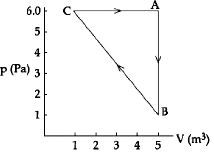
For the given cyclic process $CAB$ as shown for a gas, the work done is ..... $J$
$ABC$ is a right angled triangle in which $AB = 3\,cm$ and $BC = 4\,cm$. And  $\angle ABC = \pi /2$. The three charges $ + 15,\; + 12$ and $ - 20\,e.s.u.$ are placed respectively on $A$, $B$ and $C$. The force acting on $B$ is.......$dynes$
A plane wave is represented by $x = 1.2\sin (314\,t + 12.56y)$Where $x$ and $y$ are distances measured along in $x$ and $y$ direction in meters and $t$ is time in seconds. This wave has
Three objects, $A :$ (a solid sphere), $B :$ (a thin circular disk) and $C :$ (a circular ring), each have the same mass $M$ and radius $R.$ They all spin with the same angular speed $\omega$ about their own symmetry axes. The amounts of work $(W)$ required to bring them to rest, would satisfy the relation
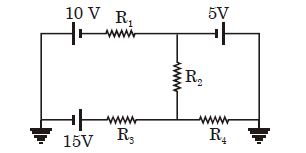
In the circuit shown, current through $R_2$ is zero. If $R_4 = 2\,\Omega $ and $R_3 = 4\,\Omega $ , current through $R_3$ will be ................. $\mathrm{A}$
A gaseous mixture consists of $16\,g$ of helium and $16\,g$ of oxygen. The ratio $\frac{{{C_P}}}{{{C_V}}}$ of the mixture is
A planet is revolving ground the sun in an elliptical orbit. Its closest distance from the sun is $r_{min}$ , the farthest distance from the sun is  $r_{max}$ . If the orbital angular velocity of the planet when it is the nearest to the sun is $\omega $, then the orbital angular velocity at the point when it is at the farthest distance from the sun is
The de$-$Broglie wavelength of electron in $3^{\text {rd }}$ orbit of $He ^{+1}$ ion is approximately (in $A^{\circ}$)
Electric charges of $+10\,\mu\, C, +5\,\mu\, C, -3\,\mu\, C$ and $+8\,\mu\, C$ are placed at the corners of a square of side$\sqrt 2\,m$ . The potential at the centre of the square is
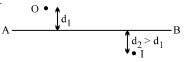
In the figure shown, the image of a real object is formed at point $I$. $AB$ is the principal axis of the mirror. The mirror must be :