MCQ
Three objects, $A :$ (a solid sphere), $B :$ (a thin circular disk) and $C :$ (a circular ring), each have the same mass $M$ and radius $R.$ They all spin with the same angular speed $\omega$ about their own symmetry axes. The amounts of work $(W)$ required to bring them to rest, would satisfy the relation
  • A
    $W_C>W_B>W_A$
  • B
    $W_A>W_B>W_C$
  • C
    $W_A>W_C>W_B$
  • D
    $W_B>W_A>W_C$

Answer

Work done required to bring a object to rest $\Delta W=\Delta K E$
$\Delta W=\frac{1}{2} I \omega^2 ;$ where $I=$ moment of inertia
For same $\omega, \Delta W \propto I$
For a solid sphere, $I_A=\frac{2}{5} M R^2$
For a thin cicular disk, $I_B=\frac{1}{2} M R^2$
For a circular ring, $I_c=M R^2$
$\therefore I_c>I_B>I_A \therefore W_c>W_B>W_A$

Need a full question paper?

Generate a complete, print-ready paper with questions like this in minutes — across 16+ boards, with answer keys.

Start Generating Free

Similar questions

A null point is found at $200\,cm$ in potentiometer when cell in secondary circuit is shunted by $5\,\Omega$. When a resistance of $15\,\Omega$ is used for shunting null point moves to $300\,cm$. The internal resistance of the cell is $..............\,\Omega$.
The control rod in a nuclear reactor is made of
At room temperature, a $P-$ type semiconductor has
A battery of $3.0\, V$ is connected to a resistor dissipating $0.5\, W$ of power. If the terminal voltage of the battery is $2.5\, V$ the power dissipated within the internal resistance is$.......W$
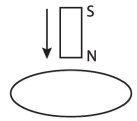
Assertion $(A):$ The bar magnet falling vertically along the axis of the horizontal coil will be having acceleration less than $g$.

Reason $(R):$ Clockwise current induced in the coil.

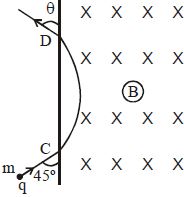
A particle of mass $m = 1.67 \times 10^{-27}\, kg$ and charge $q = 1.6 \times 10^{-19} \, C$ enters a region of uniform magnetic field of strength $1$ $tesla$ along the direction shown in the figure. The speed of the particle is $10^7\, m/s.$ The magnetic field is directed along the inward normal to the plane of the paper. The particle enters the field at $C$ and leaves at $D.$ Then the angle $\theta$ must be :-.........$^o$
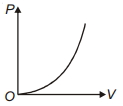
The variation of pressure $P$ with volume $V$ for an ideal diatomic gas is parabolic as shown in the figure. The molar specific heat of the gas during this process is
Two capacitors each of $1\,\mu F$ capacitance are connected in parallel and are then charged by $200\;volts$ $d.c.$ supply. The total energy of their charges (in $joules$) is
A force of $(3\,\hat i + 4\,\hat j)$ Newton acts on a body and displaces it by $(3\,\hat i + 4\hat j)\,m.$ The work done by the force is .............. $\mathrm{J}$
Within a spherical charge distribution of charge density $\rho \left( r \right)$, $N$ equipotential surfaces of potential ${V_0},{V_0} + \Delta V,{V_0} + 2\Delta V,$$.....{V_0} + N\Delta V\left( {\Delta V > 0} \right),$ are drawn and have increasing radii $r_0, r_1, r_2,......r_N$, respectively. If the difference in the radii of the surfaces is constant for all values of $V_0$ and $\Delta V$ then