The layers of atmosphere are heated through
Easy
Download our app for free and get started
(a)

Download our appand get started for free
Experience the future of education. Simply download our apps or reach out to us for more information. Let's shape the future of learning together!No signup needed.*
Similar Questions
- 1The rectangular surface of area $8$ cm $ \times $ 4cm of a black body at a temperature of ${127^o}C$ emits energy at the rate of $E$ per second. If the length and breadth of the surface are each reduced to half of the initial value and the temperature is raised to ${327^o}C$, the rate of emission of energy will becomeView Solution
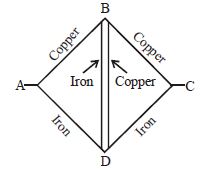
- 2Six wire each of cross-sectional area $A$ and length $l$ are combined as shown in the figure. The thermal conductivities of copper and iron are $K_1$ and $K_2$ respectively. The equivalent thermal resistance between points $A$ and $C$ is :-View Solution
- 3Hot water kept in a beaker placed in a room cools from ${70^o}C$ to $60°C$ in $4$ minutes. The time taken by it to cool from ${69^o}C$ to ${59^o}c$ will beView Solution
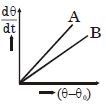
- 4Two circular discs $A$ and $B$ with equal radii and equal mass are blackened. They are heated to same temperature and are cooled under identical conditions.What inference do you draw from their cooling curves ?View Solution
- 5Assume that Solar constant is $1.4 \,kW / m ^2$, radius of sun is $7 \times 10^5 \,km$ and the distance of earth from centre of sun is $1.5 \times 10^{8} \,km$. Stefan's constant is $5.67 \times 10^{-6} \,Wm ^{-2} K ^{-4}$, find the approximate temperature of sun ....... $K$View Solution
- 6Read the following statements:View Solution
$A.$ When small temperature difference between a liquid and its surrounding is doubled the rate of loss of heat of the liquid becomes twice.
$B.$ Two bodies $P$ and $Q$ having equal surface areas are maintained at temperature $10^{\circ}\,C$ and $20^{\circ}\,C$. The thermal radiation emitted in a given time by $P$ and $Q$ are in the ratio $1: 1.15$
$C.$ A carnot Engine working between $100\,K$ and $400\,K$ has an efficiency of $75 \%$
$D.$ When small temperature difference between a liquid and its surrounding is quadrupled, the rate of loss of heat of the liquid becomes twice.
Choose the correct answer from the options given below :
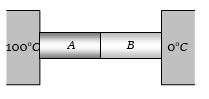
- 7Two metal cubes $A$ and $B$ of same size are arranged as shown in the figure. The extreme ends of the combination are maintained at the indicated temperatures. The arrangement is thermally insulated. The coefficients of thermal conductivity of $A$ and $B$ are $300\;W/m{\;^o}C$ and $200\;W/m{\;^o}C$, respectively. After steady state is reached, the temperature of the interface will be...... $^oC$View Solution
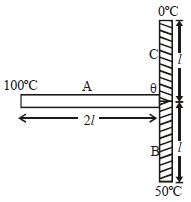
- 8Three rods $A, B$ and $C$ of thermal conductivities $K, 2\,K$ and $4\,K$, cross-sectional areas $A, 2\,A$ and $2\,A$ and lengths $2l, l$ and $l$ respectively are connected as shown in the figure. If the ends of the rods are maintained at temperatures $100^o\,C, 50^o\,C$, and $0^o\,C$ respectively, then the temperature $\theta$ of the junction is ......... $^oC$View Solution
- 9Which of the following circular rods. (given radius $ r$ and length $l$ ) each made of the same material as whose ends are maintained at the same temperature will conduct most heatView Solution
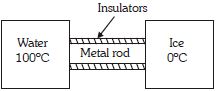
- 10An insulated container is filled with ice at $0\,^oC$ , and another container is filled with water that is continuously boiling at $100\,^oC$ . In series of experiments, the containers are connected by various thick metal rods that pass through the walls of container as shown in the figureView Solution
In the experiment $I$ : a copper rod is used and all ice melts in $20$ minutes.
In the experiment $II$ : a steel rod of identical dimensions is used and all ice melts in $80$ minutes.
In the experiment $III$ : both the rods are used in series and all ice melts in $t_{10}$ minutes.
In the experiment $IV$ : both rods are used in parallel and all ice melts in $t_{20}$ minutes.