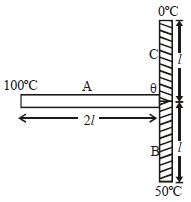
Three rods $A, B$ and $C$ of thermal conductivities $K, 2\,K$ and $4\,K$, cross-sectional areas $A, 2\,A$ and $2\,A$ and lengths $2l, l$ and $l$ respectively are connected as shown in the figure. If the ends of the rods are maintained at temperatures $100^o\,C, 50^o\,C$, and $0^o\,C$ respectively, then the temperature $\theta$ of the junction is ......... $^oC$
Diffcult
Download our app for free and get started
Let $R_{A}, R_{B}$ and $R_{C}$ be the thermal resistance of rods
$A,$ $\mathrm{B}$ and $\mathrm{C}$ respectively. Then
$\mathrm{R}_{\mathrm{A}}=\frac{2 l}{\mathrm{KA}} ; \mathrm{R}_{\mathrm{B}}=\frac{l}{2 \mathrm{K} \cdot 2 \mathrm{A}}=\frac{l}{4 \mathrm{KA}}$
and $\mathrm{R}_{\mathrm{C}}=\frac{l}{4 \mathrm{K} \cdot 2 \mathrm{A}}=\frac{l}{8 \mathrm{KA}}$
since thermal current
$\mathrm{H}=\frac{\mathrm{Q}}{\mathrm{t}}=\frac{\theta_{1}-\theta_{2}}{l / \mathrm{KA}}=\frac{\theta_{1}-\theta_{2}}{\mathrm{R}}$
or $\quad \mathrm{RH}=\theta_{1}-\theta_{2}$
$\therefore \quad 100-\theta=\mathrm{R}_{\mathrm{A}} \mathrm{H}_{\mathrm{A}}$ $...(i)$
$\theta-50=\mathrm{R}_{\mathrm{B}} \mathrm{H}_{\mathrm{B}}$ $...(ii)$
$\theta-0=\mathrm{R}_{\mathrm{c}} \mathrm{H}_{\mathrm{c}}=\mathrm{R}_{\mathrm{C}}\left(\mathrm{H}_{\mathrm{A}}-\mathrm{H}_{\mathrm{B}}\right)$ $...(iii)$
On substituting values of $\mathrm{R}_{\mathrm{A}}, \mathrm{R}_{\mathrm{B}}$ and $\mathrm{R}_{\mathrm{C}},$ we get
$100-\theta=\frac{2 l}{\mathrm{KA}} \cdot \mathrm{H}_{\mathrm{A}} \Rightarrow \mathrm{H}_{\mathrm{A}}=\frac{\mathrm{K} \mathrm{A}}{2 l}(100-\theta)$
$\theta-50=\frac{l}{4 \mathrm{KA}} \mathrm{H}_{\mathrm{B}} \Rightarrow \mathrm{H}_{\mathrm{B}}=\frac{4 \mathrm{KA}}{l}(\theta-50)$
$\theta=\frac{l}{8 \mathrm{KA}}\left(\mathrm{H}_{\mathrm{A}}-\mathrm{H}_{\mathrm{B}}\right)$
$=\frac{1}{8 \mathrm{KA}}\left[\frac{\mathrm{KA}}{2 l}(100-\theta)-\frac{4 \mathrm{KA}}{l}(\theta-50)\right]$
$\theta=20^{\circ} \mathrm{C}$

Download our appand get started for free
Experience the future of education. Simply download our apps or reach out to us for more information. Let's shape the future of learning together!No signup needed.*
Similar Questions
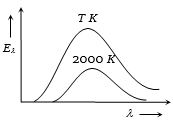
- 1The adjoining diagram shows the spectral energy density distribution ${E_\lambda }$of a black body at two different temperatures. If the areas under the curves are in the ratio $16 : 1$ , the value of temperature $T$ is ........ $K$View Solution
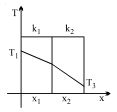
- 2The temperature drop through each layer of a two layer furnace wall is shown in figure. Assume that the external temperature $T_1$ and $T_3$ are maintained constant and $T_1 > T_3$. If the thickness of the layers $x_1$ and $x_2$ are the same, which of the following statements are correct.View Solution
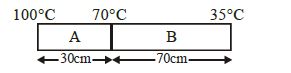
- 3Two different rods $A$ and $B$ are kept as shown in figure. The ratio of thermal conductivities of $A$ and $B$ isView Solution
- 4A bowl filled with very hot soup cools from $98^{\circ}\,C$ to $86^{\circ}\,C$ in $2$ minutes when the room temperature is $22^{\circ}\,C$. $..........\,minutes$ long it will take to cool from $75^{\circ}\,C$ to $69^{\circ}\,C$ ?View Solution
- 5View SolutionA body, which emits radiations of all possible wavelengths, is known as ...........
- 6View SolutionWhich of the following statements is wrong
- 7Read the following statements:View Solution
$A.$ When small temperature difference between a liquid and its surrounding is doubled the rate of loss of heat of the liquid becomes twice.
$B.$ Two bodies $P$ and $Q$ having equal surface areas are maintained at temperature $10^{\circ}\,C$ and $20^{\circ}\,C$. The thermal radiation emitted in a given time by $P$ and $Q$ are in the ratio $1: 1.15$
$C.$ A carnot Engine working between $100\,K$ and $400\,K$ has an efficiency of $75 \%$
$D.$ When small temperature difference between a liquid and its surrounding is quadrupled, the rate of loss of heat of the liquid becomes twice.
Choose the correct answer from the options given below :
- 8View SolutionPick out the statement which is not true
- 9View SolutionWhich of the following factors affect the thermal conductivity of a rod?
- 10If the radius of a star is $R$ and it acts as a black body, what would be the temperature of the star, in which the rate of energy production is Q? ( $\sigma$ stands for Stefan's constant.)View Solution