MCQ
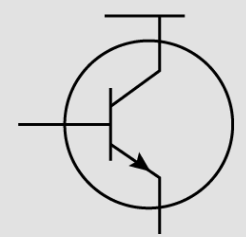
The lead marked with the arrow is the _______.
- Acollector
- Bbase
- Cemitter
- Dcore
Explanation:
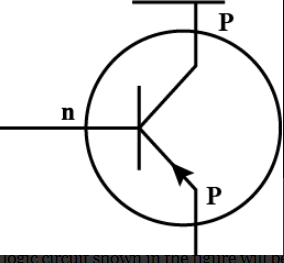
It is a p-n-p, transistor. The Lead marked with the arrow is the emitter. It tells the direction of the flow of the holes i.e, the flow of conventional current.
Generate a complete, print-ready paper with questions like this in minutes — across 16+ boards, with answer keys.
In a single slit diffraction experiment first minimum for red light (660 nm) coincides with first maximum of some other wavelength l'. The value of l' is
|
(a) 4400 Å |
(b) 6600 Å |
(c) 2000 Å |
(d) 3500 Å |
A capacitor of capacitance C1 = 1mF can with stand maximum voltage V1 = 6kV (kilo-volt) and another capacitor of capacitance C2 = 3mF can withstand maximum voltage V2 = 4 kV. When the two capacitors are connected in series, the combined system can withstand a maximum voltage of
|
(a) 4kV |
(b) 6kV |
(c) 8kV |
(d) 10kV |
The magnetic induction in the region between the pole faces of an electromagnet is 0.7 weber/m2. The induced e.m.f. in a straight conductor 10 cm long, perpendicular to B and moving perpendicular both to magnetic induction and its own length with a velocity 2 m/sec is
|
(a) 0.08 V |
(b) 0.14 V |
(c) 0.35 V |
(d) 0.07 V |
Assertion : Electric conduction in gases is possible at normal pressure.
Reason : The electric conduction in gases depends only upon the potential difference between the electrodes.
|
(a) If both assertion and reason are true and the reason is the correct explanation of the assertion. |
|
(b) If both assertion and reason are true but reason is not the correct explanation of the assertion. |
|
(c) If assertion is true but reason is false. |
|
(d) If the assertion and reason both are false. |