The length of a given cylindrical wire is increased by $100 \%$. Due to the consequent decrease in diameter the change in the resistance of the wire will be .................. $\%$
AIEEE 2003, Medium


Download our appand get started for free
Experience the future of education. Simply download our apps or reach out to us for more information. Let's shape the future of learning together!No signup needed.*
Similar Questions
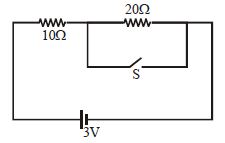
- 1Consider the circuit shown in fig. The current through the $10\,\Omega $ resistor when switch $'s'$ is $(a)$ open $(b)$ closed.View Solution
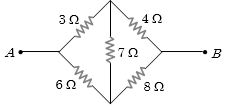
- 2Calculate the net resistance of the circuit between $A$ and $B$View Solution
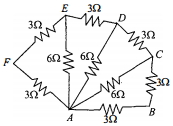
- 3Six resistors of $3 \;\Omega$ each are connected along the sides of a hexagon and three resistors of $6\; \Omega$ each are connected along $A C, A D$ and $A E$ as shown in the figure. The equivalent resistance between $A$ and $B$ is equal toView Solution
- 4A carbon resistor of $(47 \pm 4.7) \;k\Omega$ is to be marked with rings of different colours for its identification. The colour code sequence will bView Solution
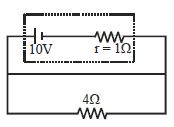
- 5Potential difference across the terminals of the battery shown in figure is .................... $V$ ($r =$ internal resistance of battery)View Solution
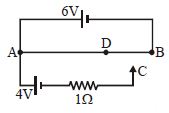
- 6View SolutionA constant voltage is applied between the two ends of a uniform metallic wire. Some heat is developed in it. The heat developed is double if
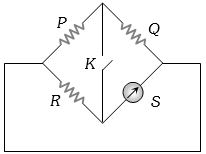
- 7In the following Wheatstone bridge $P/Q = R/S$. If key $K$ is closed, then the galvanometer will show deflectionView Solution
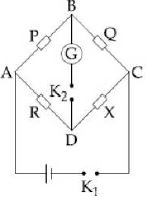
- 8In a Wheatstone bridge (see figure) Resistance $P$ and $Q$ are approximately equal. When $R = 400\,\Omega ,$ the bridge is balanced. On interchanging $P$ and $Q,$ the value of $R,$ for balance is $405\,\Omega .$ The value of $X$ is close to ................. $ohm$View Solution
- 9A student is provided with a variable voltage source $V$, a test resistor $R_T=10\,\Omega$, two identical galvanometers $G_1$ and $G_2$ and two additional resistors, $R _1=10\,M\,\Omega$ and $R _2=0.001\,\Omega$. For conducting an experiment to verify ohms law, the most suitable circuit is:View Solution
- 10A $6\, volt$ battery of negligible internal resistance resistance is connected across a uniform wire $AB$ of length $100\,cm$. The positive terminal of another battery of $emf$ $4\,V$ and internal resistance $1\,\Omega $ is joined to the point $A$ as shown in fig. Take the potential at $B$ to be zero. At which point $D$ of the wire $AB$, from left the potential is equal to the potential at $C$ ? ...................... $cm$ (approximately)View Solution