The length of a spring is $l$ and its force constant is $k$. When a weight $W$ is suspended from it, its length increases by $x$. If the spring is cut into two equal parts and put in parallel and the same weight $W$ is suspended from them, then the extension will be
Easy


Download our appand get started for free
Experience the future of education. Simply download our apps or reach out to us for more information. Let's shape the future of learning together!No signup needed.*
Similar Questions
- 1The displacement $x$ (in metres) of a particle performing simple harmonic motion is related to time $t$ (in seconds) as $x = 0.05\cos \left( {4\,\pi \,t + \frac{\pi }{4}} \right)$. The frequency of the motion will be ..... $Hz$View Solution
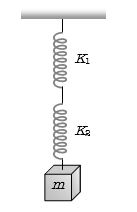
- 2A mass $M$ is suspended by two springs of force constants $K_1$ and $K_2$ respectively as shown in the diagram. The total elongation (stretch) of the two springs isView Solution
- 3A particle moves in the $x-y$ plane according to equation $\overrightarrow r = (\widehat i + 2\widehat j)\, A \, \cos \omega t$. The motion of the particle isView Solution
- 4The equation of a simple harmonic motion is $X = 0.34\cos (3000t + 0.74)$ where $X$ and $t$ are in $mm$ and $sec$. The frequency of motion isView Solution
- 5Which one of the following equations of motion represents simple harmonic motion ?View Solution
Where $k,k_0,k_1$ and $a$ are all positive
- 6The potential energy of a simple harmonic oscillator when the particle is half way to its end point is (where $E$ is the total energy)View Solution
- 7View SolutionThe total energy of a particle executing S.H.M. is proportional to
- 8The displacement of an oscillator is given by $x = a\, \sin \, \omega t + b\, \cos \, \omega t$. where $a, b$ and $\omega$ are constant. Then :-View Solution
- 9A particle executes simple harmonic motion along a straight line with an amplitude $A$. The potential energy is maximum when the displacement isView Solution
- 10The amplitude of a particle executing $S.H.M.$ with frequency of $60 \,Hz$ is $0.01 \,m$. The maximum value of the acceleration of the particle isView Solution