The length of a wire is $1.0\, m$ and the area of cross-section is $1.0 \times {10^{ - 2}}\,c{m^2}$. If the work done for increase in length by $0.2\, cm$ is $0.4\, joule$, then Young's modulus of the material of the wire is
Medium


Download our appand get started for free
Experience the future of education. Simply download our apps or reach out to us for more information. Let's shape the future of learning together!No signup needed.*
Similar Questions
- 1View SolutionWhen a spiral spring is stretched by suspending a load on it, the strain produced is called
- 2View SolutionWhich one of the following substances possesses the highest elasticity
- 3A wire of length $50\, cm$ and cross sectional area of $1$ sq. mm is extended by $1\, mm.$ The required work will be $(Y = 2 \times {10^{10}}\,N{m^{ - 2}})$View Solution
- 4A horizontal steel railroad track has a length of $100 \,m$, when the temperature is $25^{\circ} C$. The track is constrained from expanding or bending. The stress on the track on a hot summer day, when the temperature is $40^{\circ} C$ is ............. $\times 10^7\,Pa$ (Note : The linear coefficient of thermal expansion for steel is $1.1 \times 10^{-5} /{ }^{\circ} C$ and the Young's modulus of steel is $2 \times 10^{11} \,Pa$ )View Solution
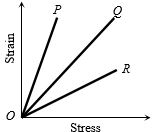
- 5The strain-stress curves of three wires of different materials are shown in the figure. $P, Q$ and $R$ are the elastic limits of the wires. The figure shows thatView Solution
- 6Join the relation of physical quantities in Column$-I$ to the details given in Column$-II$ appropriately :View Solution
Column $-I$ Column $-II$ $(a)$ Stress $\propto $ Strain $(i)$ $M^1\,L^{-1}\,T^{-2}$ $(b)$ Dimensional formula for compressibility $(ii)$ $M^{-1}\,L^{1}\,T^{-2}$ $(iii)$ Poisson’s ratio $(iv)$ Hooke’s law - 7A thick rope of density $\rho$ and length $L$ is hung from a rigid support. The Young's modulus of the material of rope is $Y$. The increase in length of the rope due to its own weight isView Solution
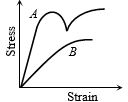
- 8The diagram shows stress v/s strain curve for the materials $A$ and $B$. From the curves we infer thatView Solution
- 9The ratio of two specific heats of gas ${C_p}/{C_v}$ for argon is $1.6$ and for hydrogen is $1.4$. Adiabatic elasticity of argon at pressure $P$ is $E.$ Adiabatic elasticity of hydrogen will also be equal to $E$ at the pressureView Solution
- 10The length of an iron wire is $L$ and area of cross-section is $A$. The increase in length is $l$ on applying the force $F$ on its two ends. Which of the statement is correctView Solution