MCQ
The length of seconds hand of a watch is $1\ cm.$ The change in velocity of its tip in $15$ seconds in $cm/ s$ is:
  • A
    $\text{zero}$
  • B
    $\frac{\text{x}}{(30\sqrt{2})}$
  • C
    $\frac{\pi}{30}$
  • $\frac{2\pi}{(30\sqrt{2})}$

Answer

Correct option: D.
$\frac{2\pi}{(30\sqrt{2})}$
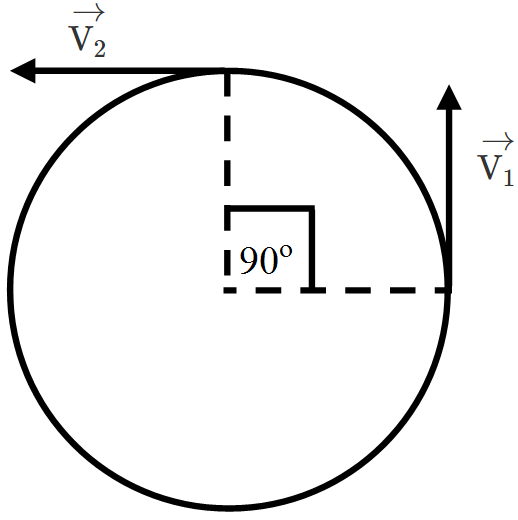
The angle described at the centre by the length of second hand of a watch in $15$ second
$=90^\circ=\frac{\pi}{2}$ radians Figure.

Linear speed $\text{v}=\text{r}\omega$
$=\frac{\text{r}\theta}{\text{t}}$
$=\frac{1\times\big(\frac{\pi}{2}\big)}{15}$
$=\frac{\pi}{30}\text{cm s}^{-1}$
Magnitude of change in velocity in $15 \sec;$
$|\Delta\vec{\text{v}}|=|\vec{\text{v}}_2-\vec{\text{v}}_1|$
$=\sqrt{\text{v}^2_2-\text{v}_1^2}$
$=\sqrt{\text{v}^2+\text{v}^2}$
$=\sqrt{2}\text{v}$
$=\sqrt{2}\frac{\pi}{30}$
$=\frac{2\pi}{30\sqrt{2}}$

Need a full question paper?

Generate a complete, print-ready paper with questions like this in minutes — across 16+ boards, with answer keys.
Start Generating Free

Similar questions

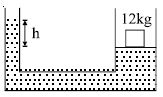
The area of cross-section of the wider tube shown in figure is $800$ $cm^2$. If a mass of $12$ $ kg $ is placed on the massless piston, the difference in heights $h$ in the level of water in the two tubes is  ........ $cm$
Consider a capacitor$-$charging circuit. Let $Q_1$ be the charge given to the capacitor in a time interval of $10 ms$ and $Q_2$ be the charge given in the next time interval of $10 ms$ . Let $10 mC$ charge be deposited in time interval $\mathrm{t}_1$ and another $10 mC$ charge be deposited in the next time interval $\mathrm{t}_2$.
A spring mass system preforms $S.H.M.$ If the mass is doubled keeping amplitude same, then the total energy of $S.H.M.$ will become :
A car is going round a circle of radius $R_1$ with constant speed. Another car is going round a circle of radius $R_2$ with constant speed. If both of them take same time to complete the circles, the ratio of their angular speeds and linear speeds will be .........
If the phase difference between the two wave is 2$\pi $ during superposition, then the resultant amplitude is
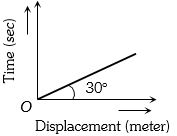
From the following displacement-time graph find out the velocity of a moving body
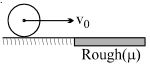
$A$ ring of mass $M$ and radius $R$ sliding with a velocity $v_0$ suddenly enters into rough surface where the coefficient of friction is $\mu$ , as shown in figure.  Choose the correct statement $(s)$
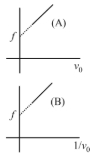
A source of sound emits sound waves at frequency $f_0$. It is moving towards an observer with fixed speed $v_s$ ($v_s < v$, where $v$ is the speed of sound in air). If the observer were to move towards the source with speed $v_0$, one of the following two graphs ($A$ and $B$) will given the correct variation of the frequency $f$ heard by the observer as $v_0$ is changed The variation of $f$ with $v_0$ is given correctly by
A solid cylinder $P$ rolls without slipping from rest down an inclined plane attaining a speed $v_p$ at the bottom. Another smooth solid cylinder $Q$ of same mass and dimensions slides without friction from rest down the inclined plane attaining a speed $v_q$ at the bottom. The ratio of the speeds $\frac{v_q}{v_p}$ is
An observer moves towards a stationary source of sound with a speed $1/5^{th}$ of the speed of sound. The wavelength and frequency of the source emitted are $\lambda $ and $f$ respectively. The apparent frequency and wavelength recorded by the observer are respectively