MCQ
The length of simple pendulum is increased by $44\%$. The percentage increase in its time period will be ..... $\%$
  • A
    $44$
  • B
    $22$
  • $20$
  • D
    $11$

Answer

Correct option: C.
$20$
c
$\frac{\mathrm{T}_{1}}{\mathrm{T}_{2}}=\sqrt{\frac{\mathrm{L}_{1}}{\mathrm{L}_{2}}}$

$\Rightarrow \frac{\mathrm{T}}{\mathrm{T}_{2}}=\sqrt{\frac{\mathrm{L}}{1.44 \mathrm{L}}}=\frac{10}{12}$

$\Rightarrow \mathrm{T}_{2}=1.2 \mathrm{T}$

$\Delta \mathrm{T}=0.2 \mathrm{T}$

$\Rightarrow \frac{\Delta \mathrm{T}}{\mathrm{T}} \times 100=20 \%$

Need a full question paper?

Generate a complete, print-ready paper with questions like this in minutes — across 16+ boards, with answer keys.
Start Generating Free

Similar questions

Conservation laws are such that:
Find time of flight of projectile thrown horizontally with speed $50 ms^{^{-1}}$ from a long inclined plane which makes an angle of $\theta = 45^o$ from horizontal  ........ $\sec$
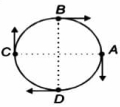
Four particles $A, B, C$ and $D$ are moving with constant speed $v$ each. At the instant shown relative velocity of $A$ with respect to $B, C$ and $D$ are in directions
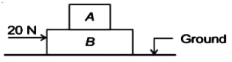
Blocks shown in figure moves with constant velocity $10 \,m / s$ towards right. All surfaces in contact are rough. The friction force applied by ground on block $B$ is ........ $N$
Two tanks $A$ and $B$ contain water at $30\,^oC$ and $80\,^oC$ respectively. Calculate the amount of water that must be taken from each tank to prepare $40\,kg$ water at $50\,^oC$
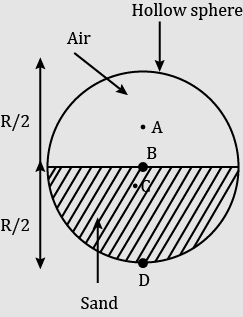
Which of the following points is the likely position of the centre of mass of the system shown in the figure ?
Image
A body $B$ lies on a smooth horizontal table and another body $A$ is placed on $B$. The coefficient of friction between $A$ and $B$ is $\mu $. What acceleration given to $B$ will cause slipping to occur between $A$ and $B$
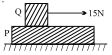
$A$ long plank $P$ of the mass $5\, kg$ is placed on a smooth floor. On $P$ is placed a block $Q$ of mass $2\, kg$. The coefficient of friction between $P$ and $Q$ is $0.5$. If a horizontal force $15N$ is applied to $Q$, as shown, and you may take $g$ as $10N/kg.$
Consider two thermometers $T_1$ and $T_2$ of equal length, which can be used to measure temperature over the range $\theta_1$ to $\theta_2$. $T_1$ contains mercury as the thermometric liquid, while $T_2$ contains bromine. The volumes of the two liquids are the same at the temperature $\theta_1$. The volumetric coefficients of expansion of mercury and bromine are $18 \times 10^{-5} \,K ^{-1}$ and $108 \times 10^{-5} \,K ^{-1}$, respectively. The increase in length of each liquid is the same for the same increase in temperature. If the diameters of the capillary tubes of the two thermometers are $d_1$ and $d_2$, respectively. Then, the ratio of $d_1: d_2$ would be closest to
An organ pipe open at one end is vibrating in first overtone and is in resonance with another pipe open at both ends and vibrating in third harmonic. The ratio of length of two pipes is