The limiting value of static friction between two contact surfaces is ...........
Easy


Download our appand get started for free
Experience the future of education. Simply download our apps or reach out to us for more information. Let's shape the future of learning together!No signup needed.*
Similar Questions
- 1View SolutionThe limiting friction between two bodies in contact is independent of
- 2Starting from rest a body slides down a $45^o$ inclined plane in twice the time it takes to slide down the same distance in the absence of friction. The co-efficient of friction between the body and the inclined plane is:View Solution
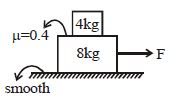
- 3........ $N$ the maximum force for which both the block will move with same acceleration.View Solution
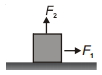
- 4In the figure shown, horizontal force $F_1$ is applied on a block but the block does not slide. Then as the magnitude of vertical force $F_2$ is increased from zero the block begins to slide; the correct statement isView Solution
- 5A railway line is taken round a circular arc of radius $1000\ m$ , and is banked by raising the outer rail $h$ $m$ above the inner rail. If the lateral force on the inner rail when a train travels round the curve at $10\ ms^{-1}$ is equal to the lateral force on the outer rail when the train's speed is $20\ ms^{-1}$ . The value of $4g\ tan\theta $ is equal to : (The distance between the rails is $1.5\ m$ )View Solution
- 6A roller coaster is designed such that riders experience "weightlessness" as they go round the top of a hill whose radius of curvature is $20\, m.$ The speed of the car at the top of the hill is betweenView Solution
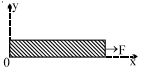
- 7A uniform rod of length $L$ and mass $M$ has been placed on a rough horizontal surface. The horizontal force $F$ applied on the rod is such that the rod is just in the state of rest. If the coefficient of friction varies according to the relation $\mu = Kx$ where $K$ is a $+$ ve constant. Then the tension at mid point of rod isView Solution
- 8A marble block of mass $2\, kg$ lying on ice when given a velocity of $6\, m/s$ is stopped by friction in $10s$. Then the coefficient of friction is-View Solution
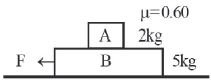
- 9Two block $(A)\,2\,kg$ and $(B)\,5\,kg$ rest one over the other on a smooth horizontal plane. The cofficient of static and dynamic friction between $(A)$ and $(B)$ is the same and equal to $0.60$. The maximum horizontal force that can be applied to $(B)$ in order that both $(A)$ and $(B)$ do not have any relative motion : $(g = 10\,m/s^2)$View Solution
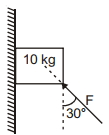
- 10A block of mass $10 \,kg$ is held at rest against a rough vertical wall $[\mu=0.5]$ under the action a force $F$ as shown in figure. The minimum value of $F$ required for it is ............ $N$ $\left(g=10 \,m / s ^2\right)$View Solution