MCQ
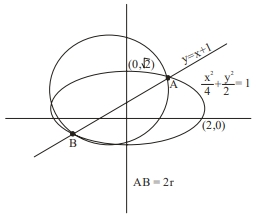
The line $y=x+1$ meets the ellipse $\frac{x^{2}}{4}+\frac{y^{2}}{2}=1$ at two points $P$ and $Q$. If $r$ is the radius of the circle with $PQ$ as diameter then $(3 r )^{2}$ is equal to
  • $20$
  • B
    $12$
  • C
    $11$
  • D
    $8$

Answer

Correct option: A.
$20$
a
Ellipse $x^{2}+2 y^{2}=4$

Line $y=x+1$

Point of intersection

$x^{2}+2(x+1)^{2}=4$

$3 x^{2}+4 x-2=0$

$\left|x_{1}-x_{2}\right|=\frac{\sqrt{40}}{3}$

$AB =2 r =\left| x _{1}- x _{2}\right| \sqrt{1+ m ^{2}}$

$m$ is slope of given line

$AB =\frac{\sqrt{40}}{3} \sqrt{1+1}$

$2 r =\frac{\sqrt{80}}{3} \Rightarrow r =\frac{\sqrt{80}}{6}$

$(3 r )^{2}=\left(3 \times \frac{\sqrt{80}}{6}\right)^{2}=\frac{80}{4}=20$
Need a full question paper?

Generate a complete, print-ready paper with questions like this in minutes — across 16+ boards, with answer keys.

Start Generating Free

Similar questions

If $ \text{f}(\text{x}) = 2\text{x} + 2-\sqrt{\frac{\text{x}}{2}}$, then $\text{f}(\text{x + y}), \text{f}(\text{x - y}) =$
Consider the parabola $y^2=8 x$. Let $\Delta_1$ be the area of the triangle formed by the end points of its latus rectum and the point $P\left(\frac{1}{2}, 2\right)$ on the parabola, and $\Delta_2$ be the area of the triangle formed by drawing tangents at $P$ and at the end points of the latus rectum. Then $\frac{\Delta_1}{\Delta_2}$ is
If $\left| x \right| < 1$, then $\mathop {\lim }\limits_{n \to \infty } \left\{ {\left( {1 + x} \right)\left( {1 + {x^2}} \right)\left( {1 + {x^4}} \right).....\left( {1 + {x^{2n}}} \right)} \right\}$ is equal to
Two dice are thrown together. If the numbers appearing on the two dice are different, then what is the probability that the sum is $6$
If $\left( {a\,\,,\,\,\frac{1}{a}} \right)$ , $\left( {b\,\,,\,\,\frac{1}{b}} \right)$ , $ \left( {c\,\,,\,\,\frac{1}{c}} \right)$ $\&$ $\left( {d\,\,,\,\,\frac{1}{d}} \right)$ are four distinct points on a circle of radius $4$ units then, $abcd$ is equal to
If $\lim _{x \rightarrow 0} \frac{ ae ^{x}- b \cos x + ce ^{- x }}{ x \sin x }=2,$ then $a + b + c$ is equal to ...........
Let S be the sum, P be the product and R be the sum of the reciprocals of 3 terms of a G.P. then $P^2R^3 : S^3$ is equal to:
If $n$ is a positive integer, then ${\left( {\frac{{1 + i}}{{1 - i}}} \right)^{4n + 1}}$=
If the normal at $(ap^2, 2ap)$ on the parabola $y^2 = 4 ax$  , meets the parabola again  at $(aq^2 , 2aq)$ , then
If a be A.M. and p, q be two G.M.'s between two numbers, then 2A is equal to: