An object of height 4.0cm is placed at a distance of 30cm from the optical centre ‘O’ of a convex lens of focal length 20cm. Draw a ray diagram to find the position and size of the image formed. Mark optical centre ‘O’ and principal focus ‘F’ on the diagram. Also find the approximate ratio of size of the image to the size of the object.
CBSE DELHI - OUTSIDE DELHI - FOREIGN SET 3 2018
Download our app for free and get started
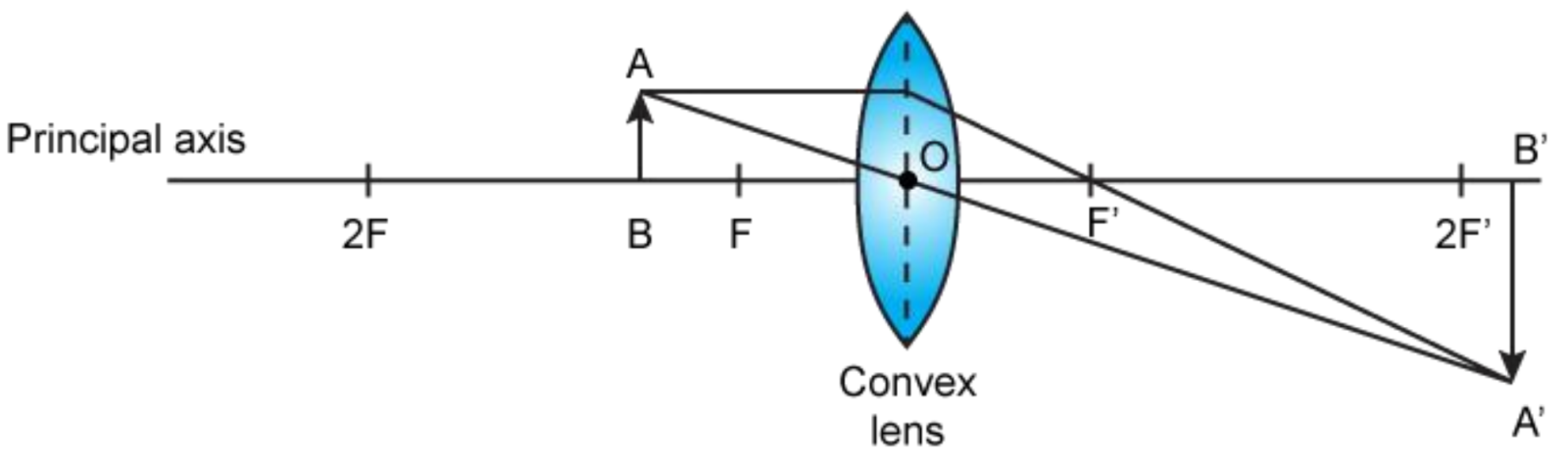
Object size $\left(h_1\right)=4 cm$
Object distance (u) = -30cm
Focal length (f) = 20cm
$\frac{1}{\text{f}}=\frac{1}{\text{v}}-\frac{1}{\text{u}}$
$\frac{1}{+20}=\frac{1}{\text{v}}-\frac{1}{-30}$
$\frac{1}{\text{v}}=\frac{1}{20}-\frac{1}{30}=0.016$
⇒ Image distance (v)= 62cm
We know that,
$\text{m}=\frac{\text{height of image (h}_2)}{\text{height of object (h}_1)}=\frac{\text{v}}{\text{u}}=\frac{62}{-30}=-2.0$
Thus the approximate ratio of height of image to height of object is -2cm.
Negative sign denotes that image formed is inverted and real.
As the value of magnification is 2, the image is magnified.
Thus nature of image is real, inverted and magnified.

Download our appand get started for free
Experience the future of education. Simply download our apps or reach out to us for more information. Let's shape the future of learning together!No signup needed.*
Similar Questions
- 1View SolutionRefractive indices of four media A, B, C and D are given below:
In which of these four media is the speed of light:MediumRefractive indexABCD1.331.441.521.65- Maximum, and
- Minimum?
- 2View SolutionA large concave mirror has a radius of curvature of 1.5m. A person stands 10m in front of the mirror. Where is the person’s image?
- 3Light travels through air at 300 million $ms ^{-1}$. On entering water it slows down to 225 million $ms ^{-1}$. Calculate the refractive index of water.View Solution
- 4View SolutionAn object 1cm tall is placed 30cm in front of a convex mirror of focal length 20cm. Find the size and position of the image formed by the convex mirror.
- 5View SolutionDiscuss the case when a convex lens forms a virtual and enlarged image.
- 6View SolutionAn object is placed at a distance of 12cm in front of a concave mirror of radius of curvature 30cm. List four characteristics of the image formed by the mirror.
- 7View SolutionA 5cm tall object is placed perpendicular to the principal axis of a convex lens of focal length 18cm at a distance of 12cm from it. Use lens formula to determine the position, size and nature to the image formed.
- 8View SolutionDraw ray diagrams showing the image formation by a concave lens when an object is placed:Between focus and twice the focal length of the lens.
- 9View SolutionThe image formed by a concave mirror is observed to be virtual, erect and larger than the object. Where should the position of the object be relative to the mirror? Draw ray diagram to justify your answer.
- 10View SolutionWith the help of a labelled diagram, explain how a concave lens diverges a beam of parallel light rays.