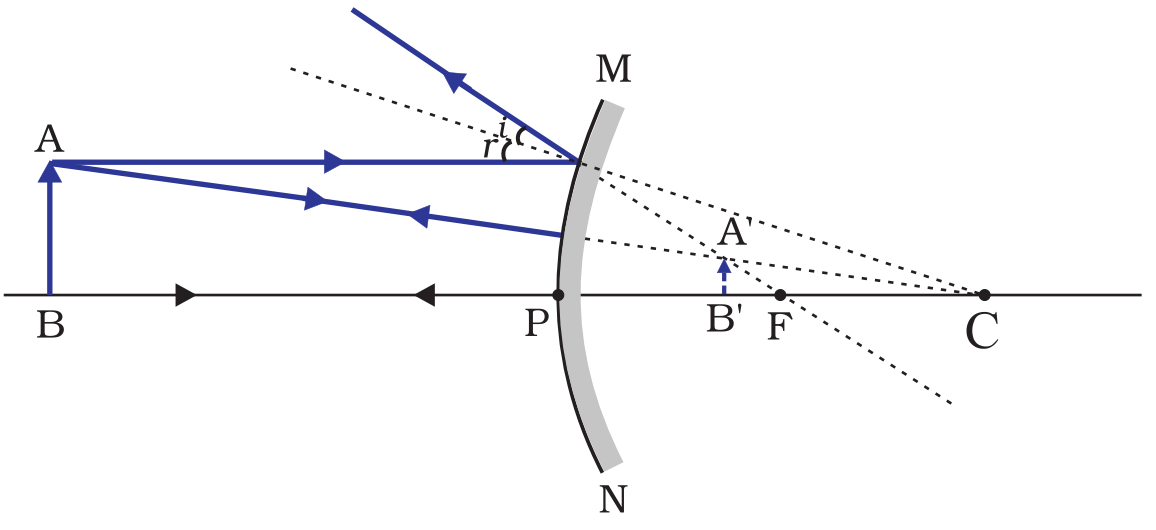
Draw ray diagrams showing the image formation by a convex mirror when an object is placed:
At finite distance from the mirror.
At finite distance from the mirror.
Download our app for free and get started

Download our appand get started for free
Experience the future of education. Simply download our apps or reach out to us for more information. Let's shape the future of learning together!No signup needed.*
Similar Questions
- 1View SolutionIf a ray of light enters from alcohol to air. The refractive index of alcohol is 1.36. Calculate the speed of light in alcohol with respect to air.
- 2View SolutionThe focal length of a lens is +150mm. What kind of lens is it and what is its power?
- 3View SolutionList four properties of the image formed by a plane mirror.
- 4View SolutionWhat are the important differences between looking at a photograph of your face and looking at yourself in a plane mirror?
- 5View SolutionThe linear magnification produced by a spherical mirror is +3. Analyse this value and state the (i) type of mirror and (ii) position of the object with respect to the pole of the mirror. Draw ray diagram to show the formation of image in this case.
- 6View SolutionWith the help of a ray diagram explain why a concave lens diverges the rays of a parallel beam of light.
- 7View SolutionAn extended object in the form of an arrow pointing upward has been placed in front of plane mirror. Draw a labelled ray-diagram to show the formation of its image.
- 8View SolutionDraw diagram to represent the action of a concave mirror on a beam of parallel light rays. Mark on this diagram principal axis, focus F, centre of curvature C, pole P and focal length ƒ, of the concave mirror.
- 9View SolutionDraw ray diagrams showing the image formation by a concave mirror when an object is placed:At infinity.
- 10What is the speed of light in a medium of refractive index $\frac{6}{5}$ if its speed in air is 3,00,000 km/ s?View Solution