The lower surface of a cube is fixed. On its upper surface, force is applied at an angle of $30°$ from its surface. The change will be of the type
Easy


Download our appand get started for free
Experience the future of education. Simply download our apps or reach out to us for more information. Let's shape the future of learning together!No signup needed.*
Similar Questions
- 1View SolutionYoung's modulus depends upon
- 2Let a wire be suspended from the ceiling (rigid support) and stretched by a weight $W$ attached at its free end. The longitudinal stress at any point of cross-sectional area $A$ of the wire is :View Solution
- 3If a spring is extended to length $l,$ then according to Hook's lawView Solution
- 4Young's modules of material of a wire of length ' $L$ ' and cross-sectional area $A$ is $Y$. If the length of the wire is doubled and cross-sectional area is halved then Young's $modules$ will be :View Solution
- 5A force $F$ is needed to break a copper wire having radius $R.$ The force needed to break a copper wire of radius $2R$ will beView Solution
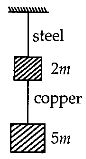
- 6If the ratio of diameters, lengths and Young's modulus of steel and copper wires shown in the figure are $p, q$ and $s$ respectively, then the corresponding ratio of increase in their lengths would beView Solution
- 7A wire of length $L$ and radius $r$ is clamped rigidly at one end. When the other end of the wire is pulled by a force $f$, its length increases by $l$. Another wire of same material of length $2 L$ and radius $2 r$ is pulled by a force $2 f$. Then the increase in its length will beView Solution
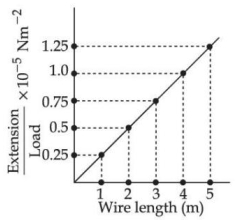
- 8In an experiment to determine the Young's modulus, steel wires of five different lengths $(1,2,3,4$ and $5\,m )$ but of same cross section $\left(2\,mm ^{2}\right)$ were taken and curves between extension and load were obtained. The slope (extension/load) of the curves were plotted with the wire length and the following graph is obtained. If the Young's modulus of given steel wires is $x \times 10^{11}\,Nm ^{-2}$, then the value of $x$ isView Solution
- 9A steel wire of length $3.2 m \left( Y _{ S }=2.0 \times 10^{11}\,Nm ^{-2}\right)$ and a copper wire of length $4.4\,M$ $\left( Y _{ C }=1.1 \times 10^{11}\,Nm ^{-2}\right)$, both of radius $1.4\,mm$ are connected end to end. When stretched by a load, the net elongation is found to be $1.4\,mm$. The load applied, in Newton, will be. (Given $\pi=\frac{22}{7}$)View Solution
- 10When a block of mass $M$ is suspended by a long wire of length $L$, the length of the wire become $(L+l) .$ The elastic potential energy stoped in the extended wire is :View Solution