Young's modules of material of a wire of length ' $L$ ' and cross-sectional area $A$ is $Y$. If the length of the wire is doubled and cross-sectional area is halved then Young's $modules$ will be :
JEE MAIN 2024, Diffcult


Download our appand get started for free
Experience the future of education. Simply download our apps or reach out to us for more information. Let's shape the future of learning together!No signup needed.*
Similar Questions
- 1The area of cross section of a steel wire $(Y = 2.0 \times {10^{11}}N/{m^2})$ is $0.1\;c{m^2}$. The force required to double its length will beView Solution
- 2Two wires of same length and radius are joined end to end and loaded. The Young's modulii of the materials of the two wires are $Y_{1}$ and $Y_{2}$. The combination behaves as a single wire then its Young's modulus is:View Solution
- 3A wire of length $5 m$ is twisted through $30^{\circ}$ at free end. If the radius of wire is $1\ mm$, the shearing strain in the wire is $..........$View Solution
- 4View SolutionMark the wrong statement
- 5Two exactly similar wires of steel and copper are stretched by equal forces. If the difference in their elongations is $0.5$ cm, the elongation $(l)$ of each wire is ${Y_s}({\rm{steel}}) = 2.0 \times {10^{11}}\,N/{m^2}$${Y_c}({\rm{copper}}) = 1.2 \times {10^{11}}\,N/{m^2}$View Solution
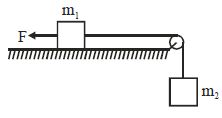
- 6Consider the situation shown in figure. The force $F$ is equal to the $m_2g/2.$ If the area of cross-section of the string is $A$ and its Young's modulus $Y$, find the strain developed in it. The string is light and there is no friction anywhereView Solution
- 7View SolutionThere are two wire of same material and same length while the diameter of second wire is two times the diameter of first wire, then the ratio of extension produced in the wires by applying same load will be
- 8A rubber cord catapult has cross-sectional area $25\,m{m^2}$ and initial length of rubber cord is $10\,cm.$ It is stretched to $5\,cm.$ and then released to project a missile of mass $5gm.$ Taking ${Y_{rubber}} = 5 \times {10^8}N/{m^2}$ velocity of projected missile is ......... $ms^{-1}$View Solution
- 9View SolutionMinimum and maximum values of Poisson’s ratio for a metal lies between
- 10In a wire of length $L,$ the increase in its length is $l.$ If the length is reduced to half, the increase in its length will beView Solution