The lowest resistance which can be obtained by connecting $10$ resistors each of $1/10$ $ohm$ is
Easy
Download our app for free and get started
(c)Lowest resistance will be in the case when all the resistors are connected in parallel.
$\frac{1}{R} = \frac{1}{{0.1}} + \frac{1}{{0.1}}$ ....... $10$ times
$\frac{1}{R} = 10 + 10$ ....... $10$ times
$\frac{1}{R} = 100$ i.e. $R = \frac{1}{{100}}\,\Omega $

Download our appand get started for free
Experience the future of education. Simply download our apps or reach out to us for more information. Let's shape the future of learning together!No signup needed.*
Similar Questions
- 1View SolutionAll of the following statements are true except
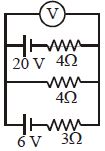
- 2What will be reading of voltmeter ................. $V$View Solution
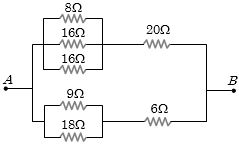
- 3The equivalent resistance of the arrangement of resistances shown in adjoining figure between the points $A$ and $B$ is ............... $ohm$View Solution
- 4Two cells of same emf but different internal resistances $I_{1}$ and $I_{2}$ are connected in series with a resistance $R$. The value of resistance $R$, for which the potential difference across second cell is zero, isView Solution
- 5When a current of $2\, A$ flows in a battery from negative to positive terminal, the potential difference across it is $12\, V$. If a current of $3\, A$ flowing in the opposite direction produces a potential difference of $15\, V$, the $emf$ of the battery is .............. $V$View Solution
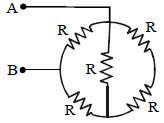
- 6The equivalent resistance between $A$ and $B$ isView Solution
- 7Two resistors $400\, \Omega$ and $800\, \Omega$ are connected in series across a $6 V$ battery. The potential difference measured by a voltmeter of $10\, k \Omega$ across $400\, \Omega$ resistor is close to$....V$View Solution
- 8The energy dissipated by a resistor is $10 \,mJ$ in $1\,s$ when an electric current of $2\, mA$ flows through it. The resistance is $....... \Omega$View Solution
(Round off to the Nearest Integer)
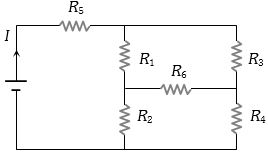
- 9In the given circuit, it is observed that the current $I$ is independent of the value of the resistance $R_6$. Then the resistance values must satisfyView Solution
- 10A wire has resistance of $24\,\Omega$ is bent in the following shape. The effective resistance between $A$ and $B$ is .............. $\Omega$View Solution