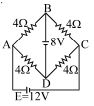
The equivalent resistance of the arrangement of resistances shown in adjoining figure between the points $A$ and $B$ is ............... $ohm$
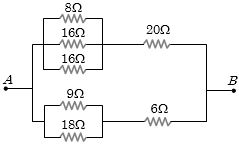
Medium

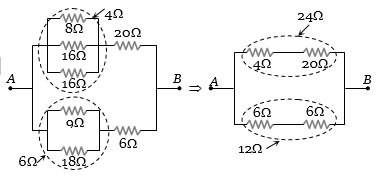

Download our appand get started for free
Experience the future of education. Simply download our apps or reach out to us for more information. Let's shape the future of learning together!No signup needed.*
Similar Questions
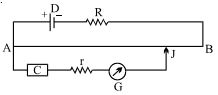
- 1In the given potentiometer circuit, the resistance of the potentiometer wire $AB$ is $R_0$. $C$ is a cell of internal resistance $r$. The galvanometer $G$ does not give zero deflection for any position of the jockey $J$. Which of the following cannot be a reason for this?View Solution
- 2In given circuit find potential difference between $P$ and $Q$ .................. $V$View Solution
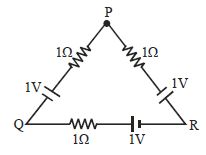
- 3View SolutionAssertion : Kirchoff 's junction rule follows from conservation of charge.
Reason : Kirchoff 's loop rule follows from conservation of momentum.
- 4Find the number of photons emitted per second from of source of light which results in a photocurrent with drift velocity of $1.5\ m/s$ in a conductor with cross-section area $0.25\ m^2$ , volume density of electrons $10^{20}\ per \ m^3$ , (Assume that $60\%$ of photons emitted result in electron emission)View Solution
- 5A $10\,m$ long potentiometer wire has a potential gradient of $0.0025\, V/cm$. Calculate the distance of null point when the wire is connected to a $1.025\,V$ standard cell ............... $\mathrm{m}$View Solution
- 6Two resistors of resistance $R_1$ and $R_2$ having $R_1 > R_2$ are connected in parallel. For equivalent resistance $R$, the correct statements isView Solution
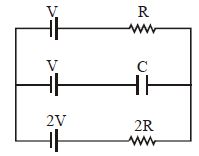
- 7View SolutionIn the given circuit, with steady current, the potential drop across the capacitor must be
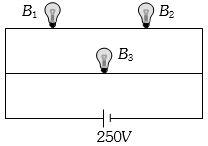
- 8A $100\, W$ bulb $B_1$, and two $60\,W$ bulbs $B_2$ and $B_3$, are connected to a $250\, V$ source, as shown in the figure. Now $ W_1, W_2$ and $W_3$ are the output powers of the bulbs $B_1, B_2$ and $B_3$, respectively. ThenView Solution
- 9A rod of length $l$ with thermally insulated lateral surface is made of a material whose thermal conductivity $K$ varies as $K = C/T$ , where $C$ is a constant. The ends are at temperatures $T_1$ and $T_2$ . The heat current density isView Solution
- 10The given figure shows $a$ network of resistances and $a$ battery. Which of the two batteries is getting charged?View Solution