The magnetic field existing in a region is given by $\vec B\, = {B_0}\,\left[ {1 + \frac{x}{l}} \right]\,\hat k\,A$ square loop of edge $l$ and carrying current $I_0$ , is placed with its edges parallel to the $x-y$ axis . Find the magnitude of the net magnetic force experienced by the loop
Diffcult
Download our app for free and get started

Download our appand get started for free
Experience the future of education. Simply download our apps or reach out to us for more information. Let's shape the future of learning together!No signup needed.*
Similar Questions
- 1A long straight wire along the $z$-axis carries a current $I$ in the negative $z$ direction. The magnetic vector field $\mathop B\limits^ \to $ at a point having coordinates $(x, y)$ in the $z = 0$ plane isView Solution
- 2Due to the flow of current in a circular loop of radius $R$, the magnetic induction produced at the centre of the loop is $B$. The magnetic moment of the loop is $({\mu _0} = {\rm{permeability}}\,{\rm{constant)}}$View Solution
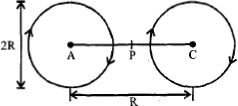
- 3A Helmholtz coil has pair of loops, each with $N$ turns and radius $R$. They are placed coaxially at distance $R$ and the same current $I$ flows through the loops in the same direction. The magnitude of magnetic field at $P$, midway between the centres $A$ and $C$, is given by (Refer to figure)View Solution
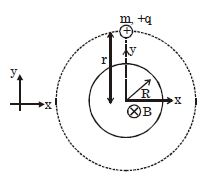
- 4Circular region of radius $R$ has uniform magnetic field $B = {B_0} + {B_0}t\left( { - \hat k} \right).\,At\,\,t\, = 0\,$ acceleration of charged particleView Solution
- 5Bob of a simple pendulum of length $l$ is made of iron . The pendulum is oscillating over a horizontal coil carrying direct current. If the time period of the pendulum is $T$ thenView Solution
- 6A proton of mass $m$ and charge $+e$ is moving in a circular orbit in a magnetic field with energy $1\, MeV$. What should be the energy of $\alpha - $particle (mass = $4m$ and charge = $+ 2e),$ so that it can revolve in the path of same radius.......$MeV$View Solution
- 7An electron has mass $9 \times {10^{ - 31}}\,kg$ and charge $1.6 \times {10^{ - 19}}C$ is moving with a velocity of ${10^6}\,m/s$, enters a region where magnetic field exists. If it describes a circle of radius $0.10\, m$, the intensity of magnetic field must beView Solution
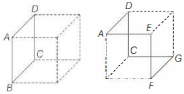
- 8The current in flowing along the path $A B C D$ of a cube (shown in the left figure) produces a magnetic field at the centre of cube of magnitude $B$. Dashed line depicts the non-conducting part of the cube. Consider a cubical shape shown to the right which is identical in size and shape to the left. If the same current now flows in along the path $D A E F G C D$, then the magnitude of magnetic field at the centre will beView Solution
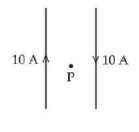
- 9Two long, straight wires carry equal currents in opposite directions as shown in figure. The separation between the wires is $5.0 \mathrm{~cm}$. The magnitude of the magnetic field at a point $P$ midway between the wires is __________$\mu \mathrm{T}$ (Given : $\mu_0=4 \pi \times 10^{-7} \mathrm{TmA}^{-1}$ )View Solution
- 10A charged particle of charge $q$ and mass $m$, gets deflected through an angle $\theta$ upon passing through a square region of side $a$, which contains a uniform magnetic field $B$ normal to its plane. Assuming that the particle entered the square at right angles to one side, what is the speed of the particle?View Solution