MCQ
The magnetic field lines:
  • A
    Intersect at right angles to one another.
  • B
    Interest at an angle 45° to each another.
  • C
    Do not cross one another.
  • D
    Cross at an angle of 60° to one another.

Answer

  1. Do not cross one another

Explanation:

Magnetic field line never intersect each other.

Need a full question paper?

Generate a complete, print-ready paper with questions like this in minutes — across 16+ boards, with answer keys.

Start Generating Free

Similar questions

An object is 100mm in front of a concave mirror which produces an upright (erect image). The radius of curvature of the mirror is:
  1. Less than 100mm.
  2. Between 100mm and 200 mm.
  3. Exactly 200mm.
  4. More than 200mm
A battery and three lamps are connected as shown?


Which of the following statements about the currents at X, Y and Z is correct?
  1. The current at Z is greater than that at Y.
  2. The current at Y is greater than that at Z.
  3. The current at X equals the current at Y.
  4. The current at X equals the current at Z.
To get 2 Ω resistance using only 6 Ω resistors, the number of them required is:
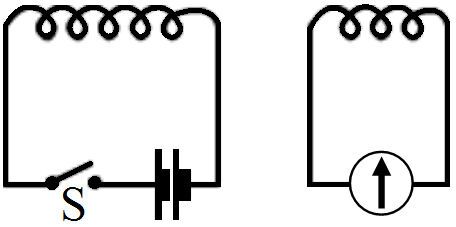
When the switch S is closed in the figure given below, the pointer of the galvanometer moves to the right.

If S is kept closed, will the pointer:
The angle of reflection is equal to the angle of incidence:
What is the resistance of a wire if its length is doubled, 
The maximum number of 40W tube-lights connected in a parallel which can safely be run from a 240V supply with a 5A fuse is:
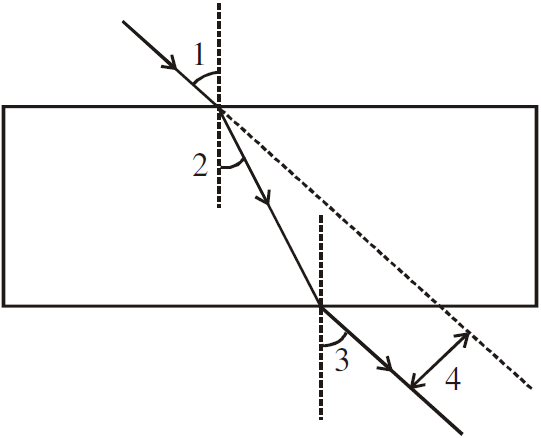
A student has traced the path of a ray of light through a glass slab as follows. If you are asked to label 1, 2, 3 and 4, the correct sequencing of labeling $\angle\text{i}, \angle\text{e}, \angle\text{r}$ and lateral displacement respectively is
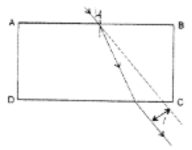
A student traces the path of a ray of light passing through a rectangular glass slab for three different values of angle of incidence (i) namely $30^{\circ}, 45^{\circ}, 60^{\circ}$. He produces the incident ray and measures the perpendicular distance, $l$, between the produced incident ray and the emergent ray.
Image 
He will observe that
The electrode potential of the neutral wire in a mains supply cable is: