MCQ
The magnetic field produced by a current $-$ carrying wire at a given point depends on:
  • The current passing through it
  • B
    The voltage across it
  • C
    The power through it
  • D
    All

Answer

Correct option: A.
The current passing through it

The magnetic field produced by a current $-$ carrying wire at a given point depends directly on the current passing through it.
Therefore, if there is a circular coil having n turns, the field produced is n times as large as that produced by a single turn.
This is because the current in each circular turn has the same direction, and the field due to each turn then just adds up.

Need a full question paper?

Generate a complete, print-ready paper with questions like this in minutes — across 16+ boards, with answer keys.
Start Generating Free

Similar questions

The constant $k$ in Coulomb's law depends upon:
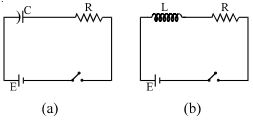
The switches in figures $(a)$ and $(b)$ are closed at $t = 0$
What is the space around a current$-$carrying conductor, in which its magnetic effect can be experienced called?
While doing his experiment, Millikan one day observed the following charges on a single drop

$(i)$ $6.563 \times {10^{ - 19}}C$       $  (ii)$ $8.204 \times {10^{ - 19}}C$

$(iii)$ $11.50 \times {10^{ - 19}}C$       $ (iv)$ $13.13 \times {10^{ - 19}}C$

$(v)$ $16.48 \times {10^{ - 19}}C$       $ (vi)$ $18.09 \times {10^{ - 19}}C$

From this data the value of the elementary charge $(e)$ was found to be

${ }_{92}^{238} A \rightarrow{ }_{90}^{234} B +{ }_2^4 D + Q$

In the given nuclear reaction, the approximate amount of energy released will be $.....\,MeV$

$\text { [Given, mass of }{ }_{92}^{238} A =238.05079 \times 931.5\,MeV / c ^2$

$\text { mass of }{ }_{90}^{234} B =234.04363 \times 931.5\,MeV / c ^2$

$\text { mass of } \left.{ }_2^4 D =4.00260 \times 931.5\,MeV / c ^2\right]$

A charged particle of charge $Q $ is held fixed and another charged particle of mass $m$ and charge $q$ (of the same sign) is released from a distance $r.$ The impulse of the force exerted by the external agent on the fixed charge by the time distance between $Q$ and $q$ becomes $2r$ is
One plano-convex and one plano-concave lens of same radius of curvature $‘R’$ but of different materials are joined side by side as shown in the figure. If the refractive index of the material of $1$ is $\mu_1$ and that of $2$ is $\mu _2$, then the focal length of the combination is
The distance between the two charges +q and -q of a dipole is r. On the axial line at a distance d from the centre of dipole, the intensity is proportional to
A concave lens made of material of refractive index $1.6$ is immersed in a medium of refractive index $2.0$. The two surfaces of the concave lens have the same radius of curvature $0.2 \,m$. The lens will behave as a
Certain galvanometers have a fixed core made of non magnetic metallic material. The function of this metallic material is