The magnetic induction in air at a point $1\,cm $ away from a long wire that carries a current of $1\,A$, will be
Easy
Download our app for free and get started
(b) $B = \frac{{{\mu _0}}}{{4\pi }} \times \frac{{2i}}{r} = {10^{ - 7}} \times \frac{{2 \times 1}}{{{{10}^{ - 2}}}} = 2 \times {10^{ - 5}}$ $Tesla$

Download our appand get started for free
Experience the future of education. Simply download our apps or reach out to us for more information. Let's shape the future of learning together!No signup needed.*
Similar Questions
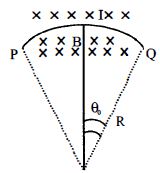
- 1A wire carrying current $I$ is tied between points $P$ and $Q$ and is in the shape of a circular arc of radius $R$ due to a uniform magnetic field $B$ (perpendicular to the plane of the paper, shown by $\times \times \times $) in the vicinity of the wire. If the wire subtends an angle $2\theta_0$ at the centre of the circle (of which it forms an arc) then the tension in the wire isView Solution
- 2The current sensitivity of a galvanometer can be increased by:View Solution
$(A)$ decreasing the number of turns
$(B)$ increasing the magnetic field
$(C)$ decreasing the area of the coil
$(D)$ decreasing the torsional constant of the spring
Choose the most appropriate answer from the options given below.
- 3A cell of emf $90\,V$ is connected across series combination of two resistors each of $100\,\Omega$ resistance. A voltmeter of resistance $400\,\Omega$ is used to measure the potential difference across each resistor. The reading of the voltmeter will be $.........\,V$View Solution
- 4Two charged particles, having same kinetic energy, are allowed to pass through a uniform magnetic field perpendicular to the direction of motion. If the ratio of radii of their circular paths is $6: 5$ and their respective masses ratio is $9: 4$. Then, the ratio of their charges will be.View Solution
- 5A positively charged $(+ q)$ particle of mass $m$ has kinetic energy $K$ enters vertically downward in a horizontal field of magnetic induction $\overrightarrow B $ . The acceleration of the particle is :-View Solution
- 6View SolutionWhich of the following loop is in stable equallibrium
- 7A current $I$ flows along the length of a thin walled, long metallic hollow cylinder of radius $R$, distributed uniformly on its surface then pressure on the wall will beView Solution
- 8Two long straight parallel wires, carrying (adjustable) current $I_1$ and $I_2$, are kept at a distance $d$ apart. If the force $'F'$ between the two wires is taken as 'positive' when the wires repel each other and 'negative' when the wires attract each other, the graph showing the dependence of $'F'$, on the product $I_1 I_2$, would beView Solution
- 9View SolutionA metallic ring with a small cut is held horizontally and a magnet is allowed to fall vertically through the ring then the acceleration of the metallic ring is :
- 10Current sensitivity of a moving coil galvanometer is $5\,div/mA$ and its voltage sensitivity (angular deflection per unit voltage applied) is $20\,div/V$. The resistance of the galvanometer is ................. $\Omega$View Solution