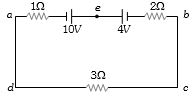
The magnitude and direction of the current in the circuit shown will be
Medium
Download our app for free and get started
Since ${E_1}(10\,V) > {E_2}(4\,V)$
So current in the circuit will be clockwise.
Applying Kirchoff's voltage law
$ - \,1 \times i + 10 - 4 - 2 \times i - 3i = 0$ $ \Rightarrow $ $i = 1\,A$ $(a$ to $b$ via $e)$
Current $ = \frac{V}{R} = \frac{{10 - 4}}{6} = 1.0\,ampere$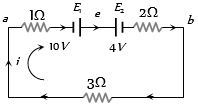

Download our appand get started for free
Experience the future of education. Simply download our apps or reach out to us for more information. Let's shape the future of learning together!No signup needed.*
Similar Questions
- 1The resistance of a conductor is $5\, ohm$ at $50\,^oC$ and $6\, ohm$ at $100\,^oC$. Its resistance at $0\,^oC$ is ................ $ohm$View Solution
- 2There are $0.8 \times 10^{23}$ free electrons $/ cm^3$ in copper. If $0.2\, A $ current is flowing is copper wire, then the drift velocity of electrons will be, if the cross sectional area of wire is $0.01 \,cm^2$View Solution
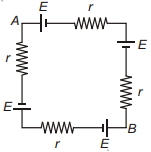
- 3Potential difference across $A B$ in the network shown is .........View Solution
- 4Two wires of equal diameters, of resistivities ${\rho _1}$ and ${\rho _2}$ and lengths $l_1$ and $l_2$, respectively, are joined in series. The equivalent resistivity of the combination isView Solution
- 5Two resistance wires on joining in parallel the resultant resistance is $\frac{6}{5}\,ohms$. One of the wire breaks, the effective resistance is $2\,ohms$. The resistance of the broken wire is ............ $ohm$View Solution
- 6The electric current through a wire varies with time as $I=I_0+\beta t$. where $I_0=20 \mathrm{~A}$ and $\beta=3 \mathrm{~A} / \mathrm{s}$. The amount of electric charge crossed through a section of the wire in $20 \mathrm{~s}$ is :View Solution
- 7The resistance of all the wires between any two adjacent dots is $R$. Then equivalent resistance between $A$ and $B$ as shown in figure is :View Solution
- 8Two resistors of resistance $R_1$ and $R_2$ having $R_1 > R_2$ are connected in parallel. For equivalent resistance $R$, the correct statements isView Solution
- 9View SolutionThe internal resistance of a cell depends on
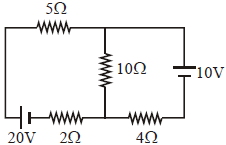
- 10In the figure shown, the current in the $10\, V$ battery is close toView Solution