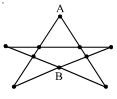
The resistance of all the wires between any two adjacent dots is $R$. Then equivalent resistance between $A$ and $B$ as shown in figure is :
Diffcult
Download our app for free and get started
As no current will pass through $\mathrm{CD}$, $CD$ arm assume to be open circuit.
$R_{1 A B}=\frac{\frac{7 R}{3} \times \frac{7 R}{3}}{\frac{7 R}{3}+\frac{7 R}{3}}=\frac{\frac{7 R}{3} \times \frac{7 R}{3}}{2 \times \frac{7 R}{3}}=\frac{7 R}{6}$
$R_{1 A B}=\frac{7 R}{6}$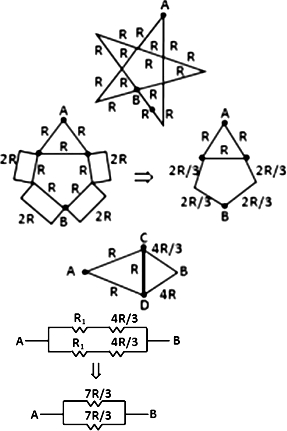

Download our appand get started for free
Experience the future of education. Simply download our apps or reach out to us for more information. Let's shape the future of learning together!No signup needed.*
Similar Questions
- 1A wire of length $5\,m$ and radius $1\,mm$ has a resistance of $1\, ohm$. What length of the wire of the same material at the same temperature and of radius $2\,mm$ will also have a resistance of $1\, ohm$ .............. $m$View Solution
- 2Current measured by the ammeter $(A)$ in the reported circuit when no current flows through $10\,\Omega$ resistance. will be________$A$View Solution
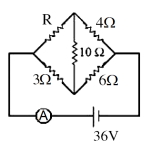
- 3If power in $3\,\Omega $ is $27\,W$ then what is the power in $2\,\Omega $ ................ $\mathrm{W}$View Solution
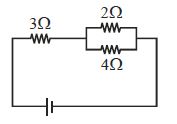
- 4Consider a metallic cube of edge length $L$. Its resistance, $R$, measured across its opposite faces is $R =\frac{ m _{ e } v }{ ne ^2 L ^2}$, where $n$ is the number density and $v$ is the drift speed of electrons in the cube, and $e$ and $m _{ e }$ are the charge and mass of an electron respectively. Assuming the de-Broglie wavelength of the electron to be $L$, the maximum resistance of the sample is closest to ............. $\,\Omega$ $\left(e=1.60 \times 10^{-19} \,C ; m _{ e }=9.11 \times 10^{-31} \,kg\right.$; Planck's constant, $h=6.63 \times 10^{-34} \,Js$ )View Solution
- 5A cell of internal resistance $1.5\,\Omega $ and of $e.m.f.$ $1.5\, volt$ balances $500\, cm$ on a potentiometer wire. If a wire of $15\,\Omega $ is connected between the balance point and the cell, then the balance point will shiftView Solution
- 6View SolutionA potential difference is applied across the ends of a metallic wire. If the potential difference is doubled, then the drift velocity
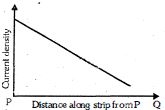
- 7An electric current flows along an insulated strip $PQ$ of a metallic conductor. The current density in the strip varies as shown in graph of figure. Which one of the following statements could explain this variation ?View Solution
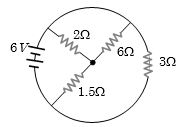
- 8The total current supplied to the circuit by the battery is ............. $A$View Solution
- 9Which arrangement of four identical resistances should be used to draw maximum energy from a cell of voltage $V$View Solution
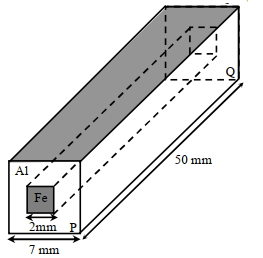
- 10In an aluminium $(A1)$ bar of square cross section, a square hole is drilled and is filled with iron ( $Fe$ ) as shown in the figure. The electrical resistivities of $A 1$ and $Fe$ are $2.7 \times 10^{-8} \ \Omega m$ and $1.0 \times 10^{-7} \ \Omega m$, respectively. The electrical resistance between the two faces $P$ and $Q$ of the composite bar isView Solution