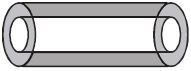
There are $0.8 \times 10^{23}$ free electrons $/ cm^3$ in copper. If $0.2\, A $ current is flowing is copper wire, then the drift velocity of electrons will be, if the cross sectional area of wire is $0.01 \,cm^2$
Easy
Download our app for free and get started
$I = neAV_d$

Download our appand get started for free
Experience the future of education. Simply download our apps or reach out to us for more information. Let's shape the future of learning together!No signup needed.*
Similar Questions
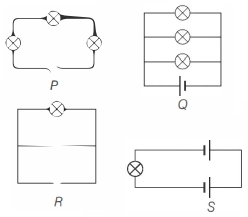
- 1Following figures show different combinations of identical bulb$(s)$ connected to identical battery$(ies)$. Which option is correct regarding the total power dissipated in the circuit?View Solution
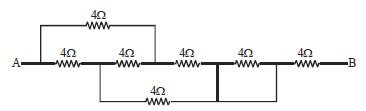
- 2Equivalent resistance between $A$ and $B$ is ............ $\Omega$View Solution
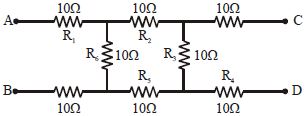
- 3The equivalent resistance between the points $A$ and $D$ ................ $\Omega$View Solution
- 4Ten $60 \,W , 220 \,V$ bulbs are connected in series to $220 \,V$ supply. Power consumed in the circuit is ......... $W$View Solution
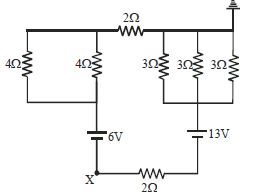
- 5Find potential at point $'x'$ in given circuit ............... $V$View Solution
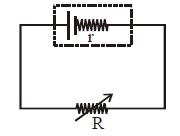
- 6Which of the following graphs represent the variation of power loss in the external load with external resistance $R$?View Solution
- 7If a wire is stretched to make it $0.1 \%$ longer, its resistance willView Solution
- 8View SolutionThermopile is used for
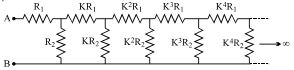
- 9The circuit diagram shown consists of a large number of element (each element has two resistors $R_1$ and $R_2$). The resistance of the resistors in each subsequent element differs by $a$ factor of $K = 1/2$ from the resistance of the resistors in the previous elements. The equivalent reistance between $A$ and $B$ shown in figure is :View Solution
- 10In given hollow cylindrical conductor current density is $J = \frac{J_0}{r^2}$ where $J_0$ is constant and $r$ is the distance from axis of cylinder. If radius of inner surface is $'a'$ and radius of outer surface is $2a$ then find current passed through the conductor.View Solution