Question
The main cause of avalanche breakdown is:

Answer

  1. Ionisation by collision.
Explanation:
Avalanche breakdown is caused by impact ionization of electron-hole pairs. A very little current flows under reverse bias conditions and depletion region increases. The electric field in the depletion region of a diode can be very high. Electron/holes that enter the depletion region undergo a tremendous acceleration.
As these accelerated carriers collide with the atoms, they can knock electrons from their bonds, creating additional electron/hole pairs and thus additional current. As these secondary carriers are swept into the depletion region, they too are accelerated and the process repeats itself.

Need a full question paper?

Generate a complete, print-ready paper with questions like this in minutes — across 16+ boards, with answer keys.
Start Generating Free

Similar questions

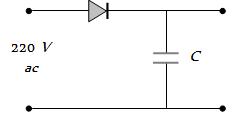
A diode is connected to $220 V ($rms$)$ ac in series with a capacitor as shown in figure. The voltage across the capacitor is
When light of wavelength 300 nm (nanometer) falls on a photoelectric emitter, photoelectrons are liberated. For another emitter, however light of 600 nm wavelength is sufficient for creating photoemission. What is the ratio of the work functions of the two emitters(a) 1 : 2(b) 2 : 1(c) 4 : 1(d) 1 : 4
       
Speed of electromagnetic waves in vacuum is:
In R - L - C series circuit, the potential differences across each element is 20V. Now the value of the resistance alone is doubled, then P.D. across R, L and C respectively.
Einstein got Nobel prize on which of the following works(a) Mass-energy relation(b) Special theory of relativity(c) Photoelectric equation(d)  (a) and (b) both
   
   
Which of the following is wrong statement about binding energy?
A uniform wire of 16 Ω  is made into the form of a square. Two opposite corners of the square are connected by a wire of resistance 16 Ω. The effective resistance between the other two opposite corners is(a) 32 Ω  (b) 20 Ω(c) 8 Ω(d) 4 Ω
       
Match the List I with the List II from the combinations shown
(I) Presbiopia (A) Sphero-cylindrical lens
(II) Hypermetropia (B) Convex lens of proper power may be used close to the eye
(III) Astigmatism (C) Concave lens of suitable focal length
(IV) Myopia (D) Bifocal lens of suitable focal length
(a) I-A; II-C; III-B; IV-D(b) I-B; II-D; III-C; IV-A(c) I-D; II-B; III-A; IV-C(d) I-D; II-A; III-C; IV-B
       
Two identical charged spherical drops each of capacitance C merge to form a single drop. The resultant capacitance is(a) Equal to 2C (b) Greater than 2C (c) Less than 2C but greater than C(d) Less than C
   
   
A capacitor of capacity $C$ is connected with a battery of potential $V$ in parallel. The distance between its plates is reduced to half at once, assuming that the charge remains the same. Then to charge the capacitance upto the potential $V$ again, the energy given by the battery will be