MCQ
The main cause of avalanche breakdown is:
- AIonisation by collision.
- BHigh doping.
- CRecombination of electrons and holes.
- DLow doping.
Explanation:
Avalanche breakdown is caused by impact ionization of electron-hole pairs. A very little current flows under reverse bias conditions and depletion region increases. The electric field in the depletion region of a diode can be very high. Electron/holes that enter the depletion region undergo a tremendous acceleration.
As these accelerated carriers collide with the atoms, they can knock electrons from their bonds, creating additional electron/hole pairs and thus additional current. As these secondary carriers are swept into the depletion region, they too are accelerated and the process repeats itself.
Generate a complete, print-ready paper with questions like this in minutes — across 16+ boards, with answer keys.
In the shown circuit, what is the potential difference across A and B
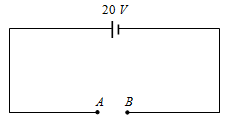
|
(a) 50 V |
(b) 45 V |
(c) 30 V |
(d) 20 V |
A magnet of magnetic moment M is rotated through 360° in a magnetic field H, the work done will be
| (a) MH | (b) 2MH | (c) 2πMH | (d) Zero |
Using a bar magnet P, a vibration magnetometer has time period 2seconds. When a bar Q (identical to P in mass and size) is placed on top of P, the time period is unchanged. Which of the following statements is true
| (a) Q is of non-magnetic material |
|
(b) Q is a bar magnet identical to P, and its north pole placed on top of P's north pole |
| (c) Q is of unmagnetized ferromagnetic material |
| (d) Nothing can be said about Q's properties |
A convex lens of focal length 12 cm is made of glass of μ =  . What will be its focal length when immersed in liquid of μ =
|
(a) 6 cm |
(b) 12 cm |
(c) 24 cm |
(d) 30 cm |
Equivalent energy of mass equal to 1 a.m.u. is
|
(a) 931 KeV |
(b) 931 eV |
(c) 931 MeV |
(d) 9.31 MeV |
The length of a given cylindrical wire is increased by 100 %. Due to the consequent decrease in diameter the change in the resistance of the wire will be
|
(a) 300 % |
(b) 200 % |
(c) 100 % |
(d) 50 % |