MCQ
The major product formed in the following reaction is

$\begin{array}{*{20}{c}}
  {\begin{array}{*{20}{c}}
  {\,\,\,\,\,\,\,C{H_3}} \\ 
  | 
\end{array}} \\ 
  {C{H_3} - C - C{H_3}} \\ 
  | \\ 
  H 
\end{array}{\mkern 1mu} $ $\mathop {\xrightarrow{{C{H_3}OBr}}}\limits_{C{H_3}OH} $

  • A
    $\begin{array}{*{20}{c}}
      {\begin{array}{*{20}{c}}
      {\,\,\,\,\,C{H_3}}\,\,\,\, \\ 
      | \,\,\,\,
    \end{array}\,\,\,\,\,\,\,\,\,\,\,\,\,} \\ 
      {C{H_3} - C - C{H_2}OC{H_3}} \\ 
      {|\,\,\,\,\,\,\,\,\,\,\,\,\,\,\,\,\,\,} \\ 
      {H\,\,\,\,\,\,\,\,\,\,\,\,\,\,\,\,\,\,} 
    \end{array}{\mkern 1mu} $
  • B
    $\begin{array}{*{20}{c}}
      {C{H_3} - CH - C{H_2}C{H_3}} \\ 
      {|\,\,\,\,\,\,\,\,\,\,\,\,\,\,\,\,\,\,} \\ 
      {OC{H_{3\,\,\,\,\,}}} 
    \end{array}$
  • C
    $\begin{array}{*{20}{c}}
      {\,\,\,\,C{H_3}} \\ 
      {|\,} \\ 
      {C{H_3} - C = C{H_2}} 
    \end{array}$
  • $\begin{array}{*{20}{c}}
      {\begin{array}{*{20}{c}}
      {\,\,\,\,\,\,C{H_3}} \\ 
      | 
    \end{array}} \\ 
      {C{H_3} - C - C{H_3}} \\ 
      | \\ 
      {\,\,\,\,\,\,\,\,\,OC{H_3}} 
    \end{array}$

Answer

Correct option: D.
$\begin{array}{*{20}{c}}
  {\begin{array}{*{20}{c}}
  {\,\,\,\,\,\,C{H_3}} \\ 
  | 
\end{array}} \\ 
  {C{H_3} - C - C{H_3}} \\ 
  | \\ 
  {\,\,\,\,\,\,\,\,\,OC{H_3}} 
\end{array}$
d
$\begin{array}{*{20}{c}}
  {\begin{array}{*{20}{c}}
  {\,\,\,\,\,C{H_3}} \\ 
  | 
\end{array}\,\,\,\,\,\,} \\ 
  {{H_3}C - C - C{H_2}Br} \\ 
  {|\,\,\,\,\,\,} \\ 
  {H\,\,\,\,\,\,} 
\end{array}$ ${\mathop{\xrightarrow{C{{H}_{3}}{{O}^{-}}}}}\,A$

Alkyl halide is  $1^o$

Keep in mind $1^o$ halide give product by ${S_{{N^2}}}$/ $E‌‌‌_2$  mechanism and $ 1^o$  halide always gives substitution reaction except when strongly hindered base is used.

ex.: With $\begin{array}{*{20}{c}}
  {\begin{array}{*{20}{c}}
  {\,\,\,\,\,\,\,\,\,C{H_3}} \\ 
  {\,\,\,\,|} 
\end{array}\,\,\,\,\,\,} \\ 
  {C{H_3} - C - O\,( - )} \\ 
  {\,\,\,|\,\,\,\,\,\,} \\ 
  {\,\,\,\,\,\,\,\,\,\,C{H_3}\,\,\,\,\,\,} 
\end{array}$ it gives mainly elimination.

The reaction involves carbocation intermediate.

i.e. $\mathop {\begin{array}{*{20}{c}}
  {\begin{array}{*{20}{c}}
  {\,\,\,C{H_3}} \\ 
  {|\,} 
\end{array}} \\ 
  {C{H_3} - C - \mathop C\limits^ \oplus  {H_3}} \\ 
  {|\,} \\ 
  {H\,} 
\end{array}}\limits_{\left( {primary{\text{ }}carbocation} \right)} $

but as it is a primary carbocation it will rearrange to give a tertiary carbocation, which completes the reaction

$\mathop {\begin{array}{*{20}{c}}
  {\,\,\,\,\,\,\,\,\,\,\begin{array}{*{20}{c}}
  {\,\,\,\,\,\,\,\,\,\,C{H_3}} \\ 
  \,\,\,\,\,\,\,| 
\end{array}} \\ 
  {C{H_3} - {C^ \oplus }} \\ 
  {\,\,\,\,\,\,\,\,\,\,\,\,\,\,\,|} \\ 
  {\,\,\,\,\,\,\,\,\,\,\,\,\,\,\,\,\,\,\,\,\,\,\,\,C{H_3}} 
\end{array}}\limits_{teritiary{\text{ }}carbocation} $

Stability of carbocation : $3^o > 2^o > 1^o > $ $\mathop C\limits^ \oplus {H_3}$

It is because the stability of a charged system is increased by dispersal of the charge. The more stable the carbocation, the faster it is formed.

$N.B.$ -Rearrangement can be done in two ways.

$\begin{array}{*{20}{c}}
  {\,\,C{H_3}} \\ 
  {\,\,|\,\,\,\,} \\ 
  {C{H_3} - C - \mathop {{\text{ }}C}\limits^ \oplus  {H_2}} \\ 
  {|\,\,\,} \\ 
  {H\,\,\,} 
\end{array}$ $\xrightarrow{{H\, - \,shift}}$ $\begin{array}{*{20}{c}}
  {\,\,\,\,\,\,C{H_3}} \\ 
  | \\ 
  {\mathop {C{H_3} - \mathop {{\text{ }}C}\limits_ \oplus   - C{H_3}}\limits_{(teritary\,\,\,carbocation)} } \\
  {{\mkern 1mu} {\mkern 1mu} {\mkern 1mu} {\mkern 1mu} {\mkern 1mu} {\mkern 1mu} {\mkern 1mu} {\mkern 1mu} {\mkern 1mu} {\mkern 1mu} {\mkern 1mu} {\mkern 1mu} } 
\end{array}$

$\begin{array}{*{20}{c}}
  {\,\,C{H_3}} \\ 
  {\,\,|\,\,\,\,} \\ 
  {C{H_3} - C - \mathop {{\text{ }}C}\limits^ \oplus  {H_2}} \\ 
  {|\,\,\,} \\ 
  {H\,\,\,} 
\end{array}$ $\xrightarrow{{CH_3\, - \,shift}}$ $\mathop {\begin{array}{*{20}{c}}
  {C{H_3} - \mathop {{\text{ }}C}\limits^ \oplus   - C{H_2} + Br} \\ 
  {|\,\,\,\,\,\,\,\,\,\,\,\,} \\ 
  {H\,\,\,\,\,\,\,\,\,\,\,\,} 
\end{array}}\limits_{{\kern 1pt} {\kern 1pt} (secondary\,\,carbocation)} $

$\begin{array}{*{20}{c}}
  {C{H_3}\,\,\,\,\,\,\,\,} \\ 
  {|\,\,\,\,\,\,\,\,\,\,\,\,\,\,} \\ 
  {C{H_3} - C - C{H_2} - Br} \\ 
  {|\,\,\,\,\,\,\,\,\,\,\,\,\,} \\ 
  {H\,\,\,\,\,\,\,\,\,\,\,\,\,\,\,} 
\end{array}$$ = \begin{array}{*{20}{c}}
  {C{H_3}\,\,\,\,\,\,\,\,\,\,\,} \\ 
  {|\,\,\,\,\,\,\,\,\,\,\,\,\,\,\,\,\,} \\ 
  {C{H_3} - C - CH_2^ \oplus  + B{r^ - }} \\ 
  {|\,\,\,\,\,\,\,\,\,\,\,\,\,\,\,\,\,\,\,} \\ 
  {H\,\,\,\,\,\,\,\,\,\,\,\,\,\,\,\,\,\,} 
\end{array}$$ \longleftrightarrow \begin{array}{*{20}{c}}
  {\,\,\,\,\,\,C{H_3}} \\ 
  | \\ 
  {C{H_3} - \mathop {{\text{ }}C}\limits_ \oplus   - C{H_3}} 
\end{array}\xrightarrow[{C{H_3}OH}]{{C{H_3}{O^ - }}}$$\begin{array}{*{20}{c}}
  {\,\,\,\,\,\,\,\,C{H_3}} \\ 
  | \\ 
  {C{H_3} - C - C{H_3}} \\ 
  | \\ 
  {\,\,\,\,\,\,\,\,\,OC{H_3}} 
\end{array}$
Need a full question paper?

Generate a complete, print-ready paper with questions like this in minutes — across 16+ boards, with answer keys.

Start Generating Free

Similar questions

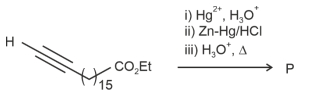
In the following reaction sequence, the major product $P$ is formed.  Glycerol reacts completely with excess $P$ in the presence of an acid catalyst to form $Q$. Reaction of $Q$ with excess $NaOH$ followed by the treatment with $CaCl _2$ yields $Ca$-soap $R$, quantitatively. Starting with one mole of $Q$, the amount of $R$ produced in gram is. . . . [Given, atomic weight: $H =1, C =12, N =14, O =16, Na =23, Cl =35, Ca =40$ ]
$\frac{1}{24.63}$ mole of an ideal mono-atomic gas undergoes a reversible process for which $PV^3= C$ where $C (L^3 -$ $atm$) is a constant. The gas expanded from initial volume of $1\, L$ and initial temperature of $300K$ to final volume of $2\, L$ then heat lost to the surroundings by gas is ......$J$
How many moles of $H_2O$ are liberatd when one mole hydrated $MgCl_2$ is heated?
The unit of equilibrium constant $K$ for the reaction $A + B$ $\rightleftharpoons$ $C$ would be
At $298\, K$ the equivalent conductivity of aniline hydrochloride of $0.01\, M$ solution is $122.5$ but in presence of sufficient excess of aniline to prevent of hydrolysis it is $106.5$. The equivalent conductivity of $HCl$ at infinite dilution is $426.0$. The hydrolysis constant of aniline is
A source of monochromatic radiation of wavelength $400\, \mathrm{~nm}$ provides $1000\, \mathrm{~J}$ of energy in $10\, seconds.$ When this radiation falls on the surface of sodium, $\mathrm{x} \times 10^{20}$ electrons are ejected per second. Assume that wavelength $400\, \mathrm{~nm}$ is sufficient for ejection of electron from the surface of sodium metal. The value of $x$ is $......$. (Nearest integer) $\left(\mathrm{h}=6.626 \times 10^{-34}\, \mathrm{Js}\right)$
$C{H_3} - C \equiv CH\xrightarrow{{Na}}X\xrightarrow{{C{H_3} - Cl}}Y$, $Y$ is
Geometrical isomerism is not possible in
Which of the following reaction is called as wurtz fittig reaction ?
The first line in the Balmer series in the $H$ atom will have the frequency :