The mass of a particle is $1\,\,kg$ and it is moving along $x-$ axis. The period of its small oscillation is $\frac {\pi }{2}$ . Its potential energy may be
Diffcult
Download our app for free and get started
$\mathrm{F}=\mathrm{ma}$
and $a=-\omega^{2} x$
$\Rightarrow a=-16 x$
so $\quad F=-16 \sin x\left[\begin{array}{c}{\text { for small oscillations }} \\ {\sin x=x} \\ {\text { and } m=1 \mathrm{kg}}\end{array}\right]$
$\mathrm{U}=-\int \mathrm{f} \mathrm{dx}=-16 \cos \mathrm{x}$

Download our appand get started for free
Experience the future of education. Simply download our apps or reach out to us for more information. Let's shape the future of learning together!No signup needed.*
Similar Questions
- 1The equation of motion of a particle is $\frac{{{d^2}y}}{{d{t^2}}} + Ky = 0$, where $K$ is positive constant. The time period of the motion is given byView Solution
- 2Displacement-time equation of a particle executing $SHM$ is $x\, = \,A\,\sin \,\left( {\omega t\, + \,\frac{\pi }{6}} \right)$ Time taken by the particle to go directly from $x\, = \, - \frac{A}{2}$ to $x\, = \, + \frac{A}{2}$ isView Solution
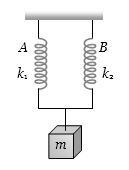
- 3A mass $m$ is suspended by means of two coiled spring which have the same length in unstretched condition as in figure. Their force constant are $k_1$ and $k_2$ respectively. When set into vertical vibrations, the period will beView Solution
- 4A simple pendulum of length $ l$ has a brass bob attached at its lower end. Its period is $T$. If a steel bob of same size, having density $ x$ times that of brass, replaces the brass bob and its length is changed so that period becomes $2T$, then new length isView Solution
- 5Two $SHM$ are represented by equations, $y_1 = 6\cos \left( {6\pi t + \frac{\pi }{6}} \right)\,,{y_2} = 3\left( {\sqrt 3 \sin 3\pi t + \cos 3\pi t} \right)$View Solution
- 6The vertical extension in a light spring by a weight of $1\, kg$ suspended from the wire is $9.8\, cm$. The period of oscillationView Solution
- 7A body executing simple harmonic motion has a maximum acceleration equal to $ 24\,metres/se{c^2} $ and maximum velocity equal to $ 16\;metres/sec $. The amplitude of the simple harmonic motion isView Solution
- 8For a particle showing motion under the force $F=-5(x-2)^2$, the motion is .......View Solution
- 9A particle is performing simple harmonic motion with amplitude A and angular velocity ${\omega }$. The ratio of maximum velocity to maximum acceleration isView Solution
- 10A particle is executing Simple Harmonic Motion $(SHM)$. The ratio of potential energy and kinetic energy of the particle when its displacement is half of its amplitude will beView Solution