The equation of motion of a particle is $\frac{{{d^2}y}}{{d{t^2}}} + Ky = 0$, where $K$ is positive constant. The time period of the motion is given by
AIEEE 2005, Easy
Download our app for free and get started
(c) On comparing with standard equation $\frac{{{d^2}y}}{{d{t^2}}} + {\omega ^2}y = 0$
we get ${\omega ^2} = K $
$\Rightarrow \omega = \frac{{2\pi }}{T} = \sqrt K$
$\Rightarrow T = \frac{{2\pi }}{{\sqrt K }}$.

Download our appand get started for free
Experience the future of education. Simply download our apps or reach out to us for more information. Let's shape the future of learning together!No signup needed.*
Similar Questions
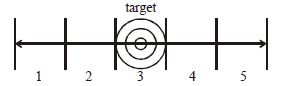
- 1View SolutionA shooting game involves using a gun that fires by itself at random times. The player can only point the gun in a fixed direction while the target moves from side to side with simple harmonic motion, as shown. At which of the given region should the player aim in order to score the greatest number of hits?
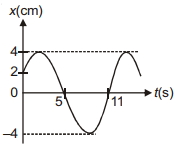
- 2Figure shows the position-time graph of an object in $S.H.M.$ The correct equation representing this motion is ..........View Solution
- 3A pendulum is hung from the roof of a sufficiently high building and is moving freely to and fro like a simple harmonic oscillator. The acceleration of the bob of the pendulum is $20\; m/s^2$ at a distance of $5\; m$ from the mean position. The time period of oscillation isView Solution
- 4$Assertion :$ For a particle performing $SHM$, its speed decreases as it goes away from the mean position.View Solution
$Reason :$ In $SHM$, the acceleration is always opposite to the velocity of the particle. - 5A uniform rod of length $2.0 \,m$ is suspended through an end and is set into oscillation with small amplitude under gravity. The time period of oscillation is approximately .... $\sec$View Solution
- 6An ideal spring with spring-constant $K$ is hung from the ceiling and a block of mass $M$ is attached to its lower end. The mass is released with the spring initially unstretched. Then the maximum extension in the spring isView Solution
- 7The vertical extension in a light spring by a weight of $1\, kg$ suspended from the wire is $9.8\, cm$. The period of oscillationView Solution
- 8Two massless springs with spring constants $2\,k$ and $2\,k$, carry $50\, g$ and $100 \,g$ masses at their free ends. These two masses oscillate vertically such that their maximum velocities are equal. Then, the ratio of their respective amplitudes will beView Solution
- 9Column $I$ describe some situations in which a small object moves. Column $II$ describes some characteristics of these motions. Match the situation in Column $I$ with the characteristics in Column $II$ and indicate your answer by darkening appropriate bubbles in the $4 \times 4$ matrix given in the $ORS$.View Solution
Column $I$ Column $II$ $(A)$ The object moves on the $\mathrm{x}$-axis under a conservative force in such a way that its "speed" and "position" satisfy $v=c_1 \sqrt{c_2-x^2}$, where $\mathrm{c}_1$ and $\mathrm{c}_2$ are positive constants. $(p)$ The object executes a simple harmonic motion. $(B)$ The object moves on the $\mathrm{x}$-axis in such a way that its velocity and its displacement from the origin satisfy $\mathrm{v}=-\mathrm{kx}$, where $\mathrm{k}$ is a positive constant. $(q)$ The object does not change its direction. $(C)$ The object is attached to one end of a massless spring of a given spring constant. The other end of the spring is attached to the ceiling of an elevator. Initially everything is at rest. The elevator starts going upwards with a constant acceleration a. The motion of the object is observed from the elevator during the period it maintains this acceleration. $(r)$ The kinetic energy of the object keeps on decreasing. $(D)$ The object is projected from the earth's surface vertically upwards with a speed $2 \sqrt{\mathrm{GM}_e / R_e}$, where, $M_e$ is the mass of the earth and $R_e$ is the radius of the earth. Neglect forces from objects other than the earth. $(s)$ The object can change its direction only once. - 10In forced oscillation of a particle the amplitude is maximum for a frequency $\omega_{1}$ of the force, while the energy is maximum for a frequency $\omega_{2}$ of the force, thenView Solution