MCQ
The mass of the electron varies with
  • A
    The size of the cathode ray tube
  • B
    The variation of ' $g$ '
  • Velocity
  • D
    Size of the electron

Answer

Correct option: C.
Velocity
Mass is basically a constant term for any physical application at low velocity. But in accordance with Einstein's theory of relativity, at higher speeds the mass of the particle change according to formula$m=\frac{m_0}{\sqrt{1-\left(v^2 / c^2\right)}}$

Need a full question paper?

Generate a complete, print-ready paper with questions like this in minutes — across 16+ boards, with answer keys.
Start Generating Free

Similar questions

The force required to take away a flat circular plate of radius $2 \mathrm{~cm}$ from the surface of water, will be (the surface tension of water is 70 dyne/cm)
The relative permeability is represented by $\mu$ and the susceptibility is denoted by $\chi$ for a magnetic substance. Then for a paramagnetic substance
How many calories of heat will be produced approximately in a $210$ watt electric bulb in $5$ minutes
The potential difference applied to an $X$-ray tube is $5 k V$ and the current through it is $3.2 \mathrm{~mA}$. Then the number of electrons striking the target per second is
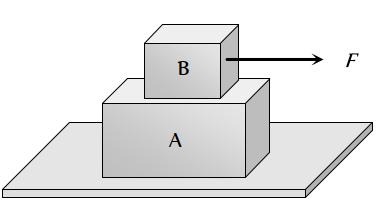
A block $B$ is placed on block $A$. The mass of block $B$ is less than the mass of block A. Friction exists between the blocks, whereas the ground on which the block $A$ is placed is taken to be smooth. A horizontal force $F$, increasing linearly with time begins to act on $B$. The acceleration $a_A$ and $a_B$ of blocks $A$ and $B$ respectively are plotted against $t$. The correctly plotted graph is
Image
Young's modulus of rubber is $10^4 N / m ^2$ and area of crosssection is $2 cm ^2$. If force of $2 \times 10^5$ dynes is applied along its length, then its initial length $I$ becomes
A tennis ball is released from height $h$ above ground level. If the ball makes inelastic collision with the ground, to what height will it rise after third collision
If the refractive angles of two prisms made of crown glass are $10$ and $20$ respectively, then the ratio of their colour deviation powers will be
The apparent depth of water in cylindrical water tank of diameter $2 R \mathrm{~cm}$ is reducing at the rate of $x \mathrm{~cm} /$ minute when water is being drained out at a constant rate. The amount of water drained in c.c. per minute is ( $n=$ refractive index of air, $n=$ refractive index of water)
Evidence for the wave nature of light cannot be obtained from