Question
The material suitable for making electromagnets should have:

Answer

  1. High retentivity and low coercivity.
Explanation:
An electromagnet is necessary for the material that even if the current is turned off, the material losses its magnetic field. So, it should be made from such a material that its retentivity is very high. And there must be enough coercion force for the material which can restore its pre-magnetization state. For that its coercivity should be as minimum as possible.

Need a full question paper?

Generate a complete, print-ready paper with questions like this in minutes — across 16+ boards, with answer keys.
Start Generating Free

Similar questions

Two independent parallel wires in which the current is flowing in the same direction. They will:
A bar magnet of magnetic moment $3.0 \mathrm{A}-\mathrm{m}^2$ is placed in a uniform magnetic induction field of $2 \times 10^{-5} \mathrm{T}.$ If each pole of the magnet experiences a force of $6 \times 10^{-4} \mathrm{N},$ the length of the magnet is
An object of size 7.5 cm is placed in front of a convex mirror of radius of curvature 25 cm at a distance of 40 cm The size of the image should be(a) 2.3 cm(b) 1.78 cm(c) 1 cm(d) 0.8 cm
       
What will be the grouping of cells when the current in the circuit is $\frac{\text{ne}}{(\text{R+nr})}$?
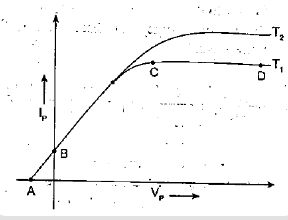
A graph of vacuum diode current $I_p​,$ is plotted against the anode voltage $V_p​$ for two different temperatures $T_{1​}$ and $T_{2​}$ of the cathode, as shown in the figure below. Study the graph and answer the following questions.
For the same anode voltage$, ($called plate voltage$),$ the current more when the cathode temperature changes from $T_1​$ to $T_2$​ higher temperature.
A charged water drop whose radius is $0.1 \mu m$ is in equilibrium in an electric field. If charge on it is equal to charge of an electron, then intensity of electric field will be $( g=10$ $ms ^{-1} )$
In YDSE, the slit widths are in the ratio of 1:9. The ratio of intensity of the maxima to that of the minima is:
A uniform electric field pointing in positive $x-$direction exists in a region. Let $A$ be the origin$, B$ be the point on the $x-$axis at $x = +1 \ cm$ and $C$ be the point on the $y-$axis at $y = +1 \ cm$. Then the potentials at the points $A, B$ and $C$ satisfy
Infrared radiation are detected by:
A thin diamagnetic rod is placed vertically between the poles of an electromagnet. When the current in the electromagnet is switched on, then the diamagnetic rod is pushed up, out of the horizontal magnetic field. Hence, the rod gains gravitational potential energy. The work required to do this comes from: