MCQ
The maximum number of possible interference maxima for slit-separation equal to twice the wavelength in Young’s double-slit experiment is
  • A
    Infinite
  • $5$
  • C
    $3$
  • D
    $0$

Answer

Correct option: B.
$5$
b
(b)For maxima $\Delta = d\sin \theta = n\lambda $
==> $2\lambda \sin \theta = n\lambda $==> $\sin \theta = \frac{n}{2}$
since value of sin $\theta$ can not be greater  $1.$
$ n = 0, 1, 2$
Therefore only five maximas can be obtained on both side of the screen.

Need a full question paper?

Generate a complete, print-ready paper with questions like this in minutes — across 16+ boards, with answer keys.
Start Generating Free

Similar questions

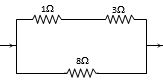
Power dissipated across the $8 \,\,\Omega$ resistor in the circuit shown here is $2\,\, watt.$ The power dissipated in watt units across the $3 \,\,\Omega$ resistor is 
If $R$ is the Rydberg’s constant for hydrogen the wave number of the first line in the Lyman series will be
The minimum wavelength of $X-$ rays produced in a coolidge tube operated at potential difference of $40 kV$ is.......$ \mathop A\limits^o $
Light of wavelength 1824 Å, incident on the surface of a metal, produces photo-electrons with maximum energy 5.3 eV. When light of wavelength 1216 Å is used, the maximum energy of photoelectrons is 8.7 eV. The work function of the metal surface is
The magnetic field near a current carrying conductor is given by
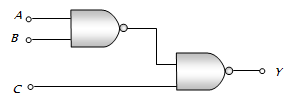
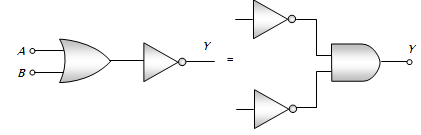
Assertion : De-morgan's theorem $\overline{A+B}=\bar{A} \cdot \bar{B}$ may be explained by the following circuit

Reason : In the following circuit, for output inputs ABC are 101
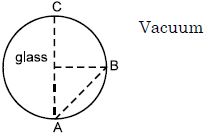
It is found that all electromagnetic sent from $A$ towards $B$ reach point $C.$ The speed of electromagnetic signals in glass can not be
To obtain $P-$type $Si$ semiconductor, we need to dope pure $Si$ with
The drift velocity of free electrons in a conductor is ‘$v$’ when a current ‘$i$’ is flowing in it. If both the radius and current are doubled, then drift velocity will be
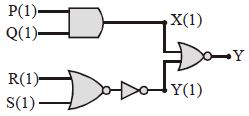
The circuit diagram shows a logic combination with the states of outputs $X, Y$ and $Z$ given for inputs $P, Q, R$ and $S$ all at state $1$. When input $P$ and $R$ change to  state $0$ with inputs $Q$ and $S$ still at $1$, the states of outputs $X, Y$ and $Z$ change to