MCQ
The maximum percentage errors in the measurement of mass (M), radius (R) and angular velocity $(\omega)$ of a ring are $2 \%, 1 \%$ and $1 \%$ respectively, then find the maximum percenta? error in the measurement of its rotational kinetic energy $\left(K=\frac{1}{2} I \omega^{2}\right)$
  • A
    $3$
  • $6$
  • C
    $4$
  • D
    $1$

Answer

Correct option: B.
$6$
b
Rotational kinetic energy $(K)=\frac{1}{2} I \omega^{2}=\frac{1}{2} M R^{2} \omega^{2}$

$\therefore \frac{\Delta K}{K} \times 100=\frac{\Delta M}{M} \times 100+2 \frac{\Delta R}{R} \times 100+2 \frac{\Delta \omega}{\omega} \times 100$

$=2 \%+(2 \times 1 \%)=6 \%$

Need a full question paper?

Generate a complete, print-ready paper with questions like this in minutes — across 16+ boards, with answer keys.

Start Generating Free

Similar questions

A bomb of mass $m$ is projected from the ground with speed $v$ at angle $\theta$ with the horizontal. At the maximum height from the ground it explodes into two fragments of equal mass. If one fragment comes to rest immediately after explosion, then the horizontal range of centre of mass is ..............
The velocity of a body at time $ t = 0$ is $10\sqrt 2 \,m/s$ in the north-east direction and it is moving with an acceleration of $ 2 \,m/s^{2}$ directed towards the south. The magnitude and direction of the velocity of the body after $5\, sec$ will be
A vessel contains a mixture of one mole of oxygen and two moles of nitrogen at $300 K$. The ratio of the average rotational kinetic energy per ${O_2}$ molecule to that per ${N_2}$ molecule is
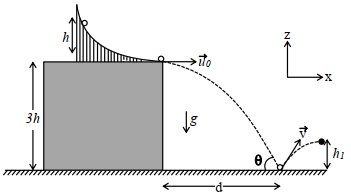
A slide with a frictionless curved surface, which becomes horizontal at its lower end,, is fixed on the terrace of a building of height $3 h$ from the ground, as shown in the figure. A spherical ball of mass $\mathrm{m}$ is released on the slide from rest at a height $h$ from the top of the terrace. The ball leaves the slide with a velocity $\vec{u}_0=u_0 \hat{x}$ and falls on the ground at a distance $d$ from the building making an angle $\theta$ with the horizontal. It bounces off with a velocity $\overrightarrow{\mathrm{v}}$ and reaches a maximum height $h_l$. The acceleration due to gravity is $g$ and the coefficient of restitution of the ground is $1 / \sqrt{3}$. Which of the following statement($s$) is(are) correct?

($AV$) $\vec{u}_0=\sqrt{2 g h} \hat{x}$ ($B$) $\vec{v}=\sqrt{2 g h}(\hat{x}-\hat{z})$  ($C$) $\theta=60^{\circ}$  ($D$) $d / h_1=2 \sqrt{3}$

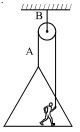
To paint the side of $a$ building, painter normally hoists himself up by pulling on the rope $A$ as in figure. The painter and platform together weigh $200N$. The rope $B$ can withstand $300N$. Then
Velocity of sound measured in hydrogen and oxygen gas at a given temperature will be in the ratio
The mass density of a spherical galaxy varies as $\frac{ K }{ r }$ over a large distance $'r'$ from its centre. In that region, a small star is in a circular orbit of radius $R$. Then the period of revolution, $T$ depends on $R$ as
The position of a particle related to time is given by $x =\left(5 t ^2-4 t +5\right) m$. The magnitude of velocity of the particle at $t=2\,s$ will be $...........ms^{-1}$
When no current is passed through a conductor:
  1. The free electrons do not move.
  2. The average speed of a free electron over a large period of time is zero.
  3. The average velocity of a free electron over a large period of time is zero.
  4. The average of the velocities of all the free electrons at an instant is zero.
A particle moves in $xy$ plane according to the law $x = a \sin \omega t$ and $y = a(1-\cos \omega t)$ where $a$ and $\omega$ are constants. The particle traces