MCQ
The maximum possible efficiency of a heat engine is ...........
  • A
    $100 \%$
  • B
    $\frac{T_1}{T_2}$
  • C
    $\frac{T_1}{T_2}+1$
  • Dependent upon the temperature of source $\left(T_1\right)$ and $\operatorname{sink}\left(T_2\right)$ and is equal to $\left(1-\frac{T_2}{T_1}\right)$
Answer

Correct option: D.
Dependent upon the temperature of source $\left(T_1\right)$ and $\operatorname{sink}\left(T_2\right)$ and is equal to $\left(1-\frac{T_2}{T_1}\right)$
d
(d)

$\eta=1-\frac{T_2}{T_1}$

So it depends on source and sink temperature.

Need a full question paper?

Generate a complete, print-ready paper with questions like this in minutes — across 16+ boards, with answer keys.

Start Generating Free

Similar questions

The resultant of two vectors $A$ and $B$ is perpendicular to the vector $A$ and its magnitude is equal to half the magnitude of vector $B$. The angle between $A$ and $B$ is ....... $^o$
In circular motion, the centripetal acceleration is given by
The mass number of a nucleus is:
Projection of vector $\vec A$ on $\vec B$ is
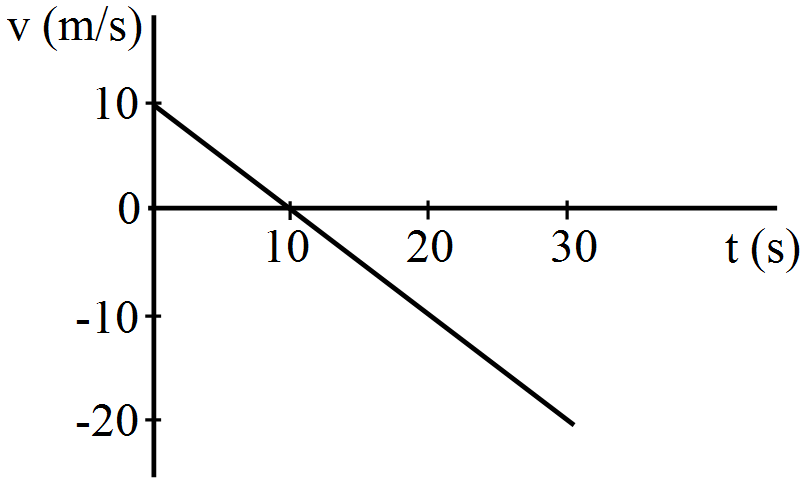
The velocity-time plot for a particle moving on a straight line is shown in the figure:
A particle executes $S.H.M.$ with amplitude $'a'$ and time period $V$. The displacement of the particle when its speed is half of maximum speed is $\frac{\sqrt{ x } a }{2} .$ The value of $x$ is $\ldots \ldots \ldots$
The efficiency of an engine working between temperatures $T _1$ and $T _2$ is :
A force $\overrightarrow{ F }=(\hat{ i }+2 \hat{ j }+3 \hat{ k }) N$ acts at a point $(4 \hat{ i }+3 \hat{ j }-\hat{ k }) m \cdot$ Then the magnitude of torque about the point $(\hat{i}+2 \hat{j}+\hat{k}) m$ will be $\sqrt{ x } N - m .$ The value of $x$ is$........$
What is the mass of $2$ litres of nitrogen at $22.4$ atmospheric pressure and $273\,K$
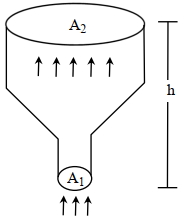
An ideal gas of density $\rho=0.2 kg m ^{-3}$ enters a chimney of height $h$ at the rate of $\alpha=0.8 kg s ^{-1}$ from its lower end, and escapes through the upper end as shown in the figure. The cross-sectional area of the lower end is $A_1=0.1 m ^2$ and the upper end is $A_2=0.4 m ^2$. The pressure and the temperature of the gas at the lower end are $600 Pa$ and $300 K$, respectively, while its temperature at the upper end is $150 K$. The chimney is heat insulated so that the gas undergoes adiabatic expansion. Take $g=10 ms ^{-2}$ and the ratio of specific heats of the gas $\gamma=2$. Ignore atmospheric pressure.

Which of the following statement($s$) is(are) correct?