A train is running at $20 \,m / s$ on a railway line with radius of curvature $40,000$ metres. The distance between the two rails is $1.5$ metres. For safe running of train the elevation of outer rail over the inner rail is ......$mm$ $\left( g =10 \,m / s ^2\right)$
Medium


Download our appand get started for free
Experience the future of education. Simply download our apps or reach out to us for more information. Let's shape the future of learning together!No signup needed.*
Similar Questions
- 1A body of $5 \,kg$ weight kept on a rough inclined plane of angle $30^{\circ}$ starts sliding with a constant velocity. Then the coefficient of friction is (assume $g=10 \,ms ^{-2}$ )View Solution
- 2$A$ particle inside the rough surface of $a$ rotating cone about its axis is at rest relative to it at $a$ height of $1m$ above its vertex. Friction coefficient is $\mu = 0.5$, if half angle of cone is $45^o$, the maximum angular velocity of revolution of cone can be :View Solution
- 3A car of mass $m$ is moving on a level circular track of radius $R.$ If $\mu_s $ represents the static friction between the road and tyres of the car, the maximum speed of the car in circular motion is given byView Solution
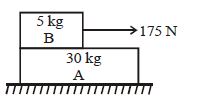
- 4Block $A$ of mass $30\, kg$ . is resting on a frictionless floor. Another block $B$ of mass $5\, kg$ is resting on it as shown in the figure. The coefficient of static friction between the blocks is $0.4$ while kinetic friction is $0.3$. If a horizontal force of $175\, N$ is applied to block $B$ , then the acceleration of the block $A$ will be ........ $m/s^2$ $(g = 10\, m/s^2 )$View Solution
- 5A horizontal force of $129.4 \,N $ is applied on a $10\, kg$ block which rests on a horizontal surface. If the coefficient of friction is $0.3$, the acceleration should be ....... $m/s^2$View Solution
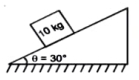
- 6A block of mass $10 \,kg$ is kept on a fixed rough $(\mu=0.8)$ inclined plane of angle of inclination $30^{\circ}$. The frictional force acting on the block is ........... $N$View Solution
- 7A car is moving on a horizontal curved road with radius $50\,m$. The approximate maximum speed of car will be $............\,ms^{-1}$, if friction between tyres and road is $0.34.\left[\right.$ Take $\left.g =10 ms ^{-2}\right]$View Solution
- 8A $2\,kg$ block slides on a horizontal floor with a speed of $4\, m/s$. It strikes a uncompressed spring, and compresses it till the block is motionless. The kinetic friction force is $110\,N$ and spring constant is $1000\, N/m$. The spring compresses by ........ $cm$View Solution
- 9A car of mass $1000\, kg$ negotiates a banked curve of radius $90\, m$ on a frictionless road. If the banking angle is $45^o $, the speed of the car is ....... $ms^{-1}$View Solution
- 10A uniform rope of length l lies on a table. If the coefficient of friction is $\mu $, then the maximum length ${l_1}$ of the part of this rope which can overhang from the edge of the table without sliding down isView Solution