A block slides down on incline of angle $30^o$ with an acceleration $\frac{g}{4}$. Find the coefficient of kinetic friction
Medium


Download our appand get started for free
Experience the future of education. Simply download our apps or reach out to us for more information. Let's shape the future of learning together!No signup needed.*
Similar Questions
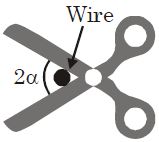
- 1Someone is using a scissors to cut a wire of circular cross section and negligible weight. The wire slides in the direction away from the hinge until the angle between the scissors blades becomes $2 \alpha$. The friction coefficient between the blades and the wire, is :-View Solution
- 2A cart moves with a constant speed along $a$ horizontal circular path. From the cart, $a$ particle is thrown up vertically with respect to the cartView Solution
- 3A rope of length $L$ and mass $M$ is being pulled on a rough horizontal floor by a constant horizontal force $F$ = $Mg$ . The force is acting at one end of the rope in the same direction as the length of the rope. The coefficient of kinetic friction between rope and floor is $1/2$ . Then, the tension at the midpoint of the rope isView Solution
- 4Put a uniform meter scale horizontally on your extended index fingers with the left one at $0.00 cm$ and the right one at $90.00 cm$. When you attempt to move both the fingers slowly towards the center, initially only the left finger slips with respect to the scale and the right finger does not. After some distance, the left finger stops and the right one starts slipping. Then the right finger stops at a distance $x_R$ from the center ( $50.00 cm$ ) of the scale and the left one starts slipping again. This happens because of the difference in the frictional forces on the two fingers. If the coefficients of static and dynamic friction between the fingers and the scale are $0.40$ and $0.32$ , respectively, the value of $x_R($ in $cm )$ is. . . . . . .View Solution
- 5A block of mass $m$ (initially at rest) is sliding up (in vertical direction) against a rough vertical wall with the help of a force $F$ whose magnitude is constant but direction is changing. $\theta = {\theta _0}t$ where $t$ is time in sec. At $t$ = $0$ , the force is in vertical upward direction and then as time passes its direction is getting along normal, i.e., $\theta = \frac{\pi }{2}$ .The value of $F$ so that the block comes to rest when $\theta = \frac{\pi }{2}$ , isView Solution
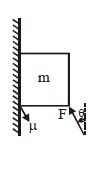
- 6$10\, kg$ block is placed as shown, if $F = 50$ newton find friction force ............ $N$View Solution
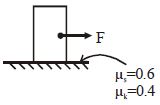
- 7View SolutionA man pulls a block heavier than himself with a light horizontal rope. The coefficient of friction is the same between the man and the ground, and between the block and the ground
- 8A $2 \mathrm{~kg}$ brick begins to slide over a surface which is inclined at an angle of $45^{\circ}$ with respect to horizontal axis. The co-efficient of static friction between their surfaces is:View Solution
- 9A $100 \,kg$ car is moving with a maximum velocity of $9 \,m/s$ across a circular track of radius $30\,m$. The maximum force of friction between the road and the car is ........ $N$View Solution
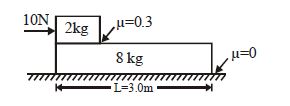
- 10Determine the time in which the smaller block reaches other end of bigger block in the figure. $(g = 10\ m s^{-2})$ .......... $\sec$View Solution