The maximum velocity to which a proton can be accelerated in a cyclotron of $10\, MHz$ frequency and radius $50\, cm$ is
Easy


Download our appand get started for free
Experience the future of education. Simply download our apps or reach out to us for more information. Let's shape the future of learning together!No signup needed.*
Similar Questions
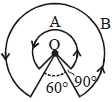
- 1A wire $A$, bent in the shape of an arc of a circle, carrying a current of $2\, A$ and having radius $2\, cm$ and another wire $B ,$ also bent in the shape of arc of a circle, carrying a current of $3\, A$ and having radius of $4\, cm ,$ are placed as shown in the figure. The ratio of the magnetic fields due to the wires $A$ and $B$ at the common centre $O$ isView Solution
- 2An electron having kinetic energy $T$ is moving in a circular orbit of radius $R$ perpendicular to a uniform magnetic induction $\vec B$ . If kinetic energy is doubled and magnetic induction tripled, the radius will becomeView Solution
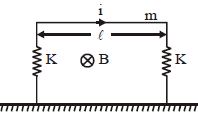
- 3A horizontal metallic rod of mass $'m'$ and length $'l'$ is supported by two vertical identical springs of spring of spring constant $'K'$ each and natural length $l_0.$ A current $'i'$ is flowing in the rod in the direction shown. If the rod is in equilibrium then the length of each spring in this state is :-View Solution
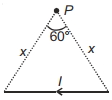
- 4A straight wire of finite length carrying current $l$ subtends an angle of $60^{\circ}$ at point $P$ as shown. The magnetic field at $P$ isView Solution
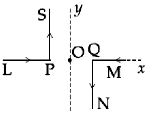
- 5As shown in the figure, two infinitely long, identical wires are bent by $90^o$ and placed in such a way that the segments $LP$ and $QM$ are along the $x-$ axis, while segments $PS$ and $QN$ are parallel to the $y-$ axis. If $OP = OQ = 4\, cm$, and the magnitude of the magnetic field at $O$ is $10^{-4}\, T$, and the two wires carry equal current (see figure), the magnitude of the current in each wire and the direction of the magnetic field at $O$ will be $(\mu_ 0 = 4\pi \times10^{-7}\, NA^{-2})$View Solution
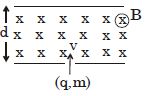
- 6View SolutionA charged particle projected in a limited magnetic field according to figure. The charged particle does not strike to the opposite plate provided
- 7A coaxial cable consists of an inner wire of radius $'a'$ surrounded by an outer shell of inner and outer radii ' ${b}$ ' and '$c$' respectively. The inner wire carries an electric current is, which is distributed uniformly across cross-sectional area. The outer shell carries an equal current in opposite direction and distributed uniformly. What will be the ratio of the magnetic field at a distance ${x}$ from the axis when $(i)$ ${x}<{a}$ and $(ii)$ ${a}<{x}<{b}$ ?View Solution
- 8A particle having some charge is projected in $x-y$ plane with a speed of $5\ m/s$ in a region having uniform magnetic field along $z-$ axis. Which of the following cannot be the possible value of velocity at any time ?View Solution
- 9A long straight wire along the $z$-axis carries a current $I$ in the negative $z$ direction. The magnetic vector field $\mathop B\limits^ \to $ at a point having coordinates $(x, y)$ in the $z = 0$ plane isView Solution
- 10A proton is projected with a velocity $10^7\, m/s$, at right angles to a uniform magnetic field of induction $100\, mT$. The time (in second) taken by the proton to traverse $90^o$ arc is $(m_p = 1.65\times10^{-27}\, kg$ and $q_p = 1.6\times10^{-19}\, C)$View Solution